

A stationery shop does not start with a lease or a shop sign. It starts with two questions: who will buy, and what will they buy from you rather than from the supermarket on the way home? The answers determine the sales format, the range matrix and the size of the first order. Below is the sequence of steps, from choosing the customer to the first delivery from a wholesale supplier.
In brief
- Define the customer first: pupils and parents, offices, students, people who draw and craft. Each group has its own basket and its own season.
- The opening range is a fast-moving core (exercise books, notebooks, pens, pencils, folders) plus a few groups tested in small quantities.
- The budget is made up of goods, delivery, premises or an online shop, fittings and a reserve for reordering.
- At EnjoyCommerce the minimum order value is EUR 500 net per item, so a range can be tested without a large stockroom.
- The main season is back to school; goods for it are ordered 2–3 months ahead.
Customers and sales format
Stationery is bought by four different groups, and serving all of them from one small shop is difficult. Parents of schoolchildren arrive with a list and want to tick it off in one visit: they care about a complete range and a clear price. Offices and small businesses need regular supplies of consumables and a proper invoice. Students and adults who keep planners and journals buy with their eyes: cover, paper, colour. People who draw or craft look for materials an ordinary supermarket does not stock.
The format follows from the customer.
- A physical shop near a school, a university or in a residential area lives on footfall and the school season. It needs a broad core and a display where an item from the list is easy to find.
- An online shop allows a narrow specialism: planners and diaries, artists’ materials, gift stationery. Photographs, descriptions and dispatch speed decide the sale.
- A marketplace – Amazon, eBay or Etsy – brings a ready flow of buyers, but also direct price comparison. Sets and bundles work better, because they are hard to compare with the listing next to them.
- B2B customers – offices, schools, training centres, co-working spaces – buy less often but in larger quantities, and they reorder. They value a stable range and correct paperwork.
The opening range
It helps to split the range into three layers. The first is the core that is asked for every day: notebooks and exercise books, pens, graphite pencils, erasers, rulers, glue. It takes up most of the shelf space and most of the turnover, and here availability matters more than originality.

A hardcover notebook in two formats and ten colours is a core item for both the office and the student.
The second layer is the school and creative group: coloured and graphite pencils, paints, drawing pads, geometry sets. Demand rises sharply before the school year and stays level for the rest of it.
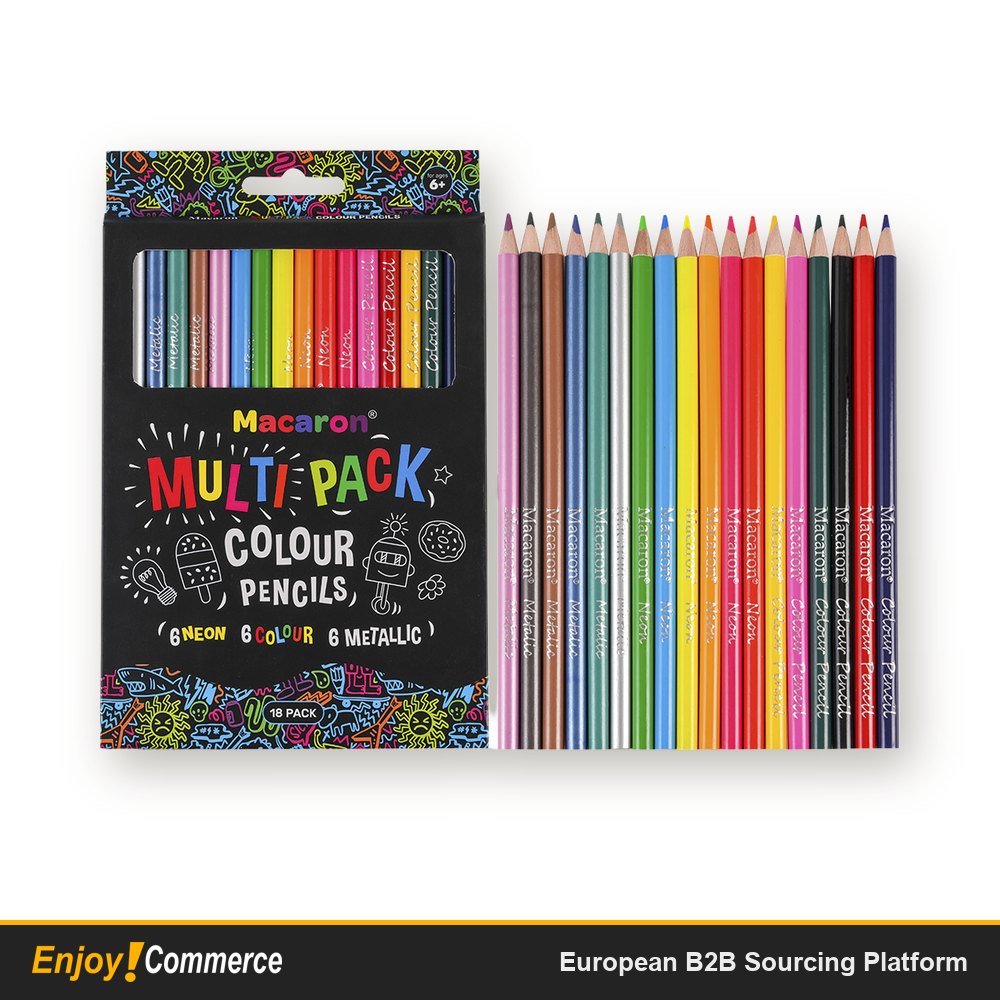
An 18-colour pencil set in a cardboard pack is an item found on almost every school list.

A geometry set with a compass in a case is bought at the start of the school year and replaced during it.
The third layer is organising and filing: document folders, sticky notes, page markers, covers. Pupils and offices both buy these, so they sell all year round.

A coloured A4 polypropylene folder with a tab is a consumable item bought by pupils and offices alike.
Beyond the core, leave room for trials: diaries, gift sets, sketchbooks, ring planners. Order a few pieces of each in different colours and watch what sells. A useful reference is the selection of products for stationery shops, compiled from the catalogue range.
What the start-up budget is made up of
Quoting sums without reference to town, floor space and format is pointless, so it is more useful to list the cost items and calculate each one for your own conditions.
- Goods. The first purchase of the core and the trial groups. Calculate it from the matrix: number of items, depth of stock and net wholesale price.
- Delivery. The cost is calculated for the specific consignment, so ask for it together with the quotation.
- Premises and fittings for a physical shop: rent, shelving, hooks and trays for small items, a till. For online sales: the shop platform, photography, packing materials.
- Registration and accounts. Setting up the business, an accountant, till equipment in line with the rules of the country.
- Promotion. A sign and wayfinding for the shop; advertising and commission for the online shop and marketplaces.
- A reserve for the second order. The estimated lead time is 20–60 days, so money for reordering fast-moving items is needed before the takings from the first delivery come back.
The supplier and the first order
A retail shop needs a supplier from whom a broad matrix can be assembled in one order, without large minimum quantities for every item. At EnjoyCommerce a purchase runs as follows:
- Register as a wholesale buyer: after registration, net prices by volume tier become visible.
- Put together the list of items and send a request. The minimum order value is EUR 500 net per item; each item in the request is counted separately.
- A manager sends a quotation with prices, timing and the delivery calculation. The whole process is set out in the buyer’s guide.
- Once the terms are agreed, you receive a pro forma invoice and pay it by bank transfer in EUR or PLN – it is worth reading the payment terms beforehand.
- The goods are shipped or manufactured and pass quality control before dispatch.
- You receive a tracking number and the documents. Delivery covers all EU countries, with an estimated lead time of 20–60 days.
Invoices are issued by a Polish company with an EU VAT number. For EU companies with a valid EU VAT number, an intra-Community supply under the reverse charge mechanism is possible; your accountant will advise how to record it.
Documents and product requirements
Business registration, the tax regime and the requirements for retail premises depend on the country – check them with an accountant or the local authority before signing a lease.
The goods themselves are covered in the EU by the General Product Safety Regulation (GPSR): the product or its packaging must carry the details of the manufacturer and of the responsible person in the EU. Part of the range may fall under separate rules: products intended for children’s play are toys and require CE marking. If there is doubt about which category an item belongs to – a craft set, paints, crayons for young children – ask the manufacturer for certificates and declarations before payment. At EnjoyCommerce they are provided on request.
Seasonality and the buying calendar
A stationery shop has one large peak and several small ones.
- Back to school – late summer and early autumn. The goods must be on the shelf before parents receive their lists, so the request goes to the supplier 2–3 months earlier, in late spring or early summer.
- The end of the year – diaries and planners for the following year, gift sets. These are ordered in late summer or early autumn.
- The second half of the school year – topping up exercise books, pens and consumables after the winter break.
- Office demand is steady, with a lift at the start of the calendar year and after the holiday period.
Typical mistakes at the start
- A matrix that is too wide. Hundreds of items at one piece each look like choice, but the fast sellers are gone within a week. Fewer lines with sufficient stock work better.
- Buying to personal taste. Attractive notebooks please the owner, but turnover comes from pens, exercise books and folders. Core first, mood second.
- Ordering for school at the last minute. A request sent in the middle of summer risks arriving after the peak.
- No sales records by item. Without them the second order is guesswork. A simple spreadsheet is enough if it is kept from day one.
- Overlooking requirements. Documents for the children’s range are requested before payment, not after a customer complaint.
Frequently asked questions
Is it possible to start with a small order?
Yes. The minimum order value is EUR 500 net per item. That is enough to assemble a trial matrix from several groups, each item from EUR 500 net, and test demand before committing to deep stock.
Which is better: a physical shop or an online shop?
It depends on the customer. The school range sells better near a school, where being able to buy everything at once matters. A narrow specialism – planners, drawing materials, gift stationery – finds buyers more easily online and on marketplaces, where reach is not limited to the neighbourhood.
When should goods for the school season be ordered?
Two to three months before sales begin. The estimated lead time is 20–60 days; add the time needed to agree the quotation, make the payment and receive the goods.
Are certificates needed for stationery?
It depends on the category. General safety requirements apply to all consumer products, while items covered by separate rules – toys, for example – require CE marking. Ask the manufacturer for certificates and declarations before payment and keep them with the documents for the consignment.
A stationery shop rests on a predictable core and on hitting the season on time. Start with the customer, build a short matrix, test it with a small order and expand what sells. Items can be chosen in the Stationery Shops section, and once there are regular customers it is worth reading how to create your own stationery brand.
