
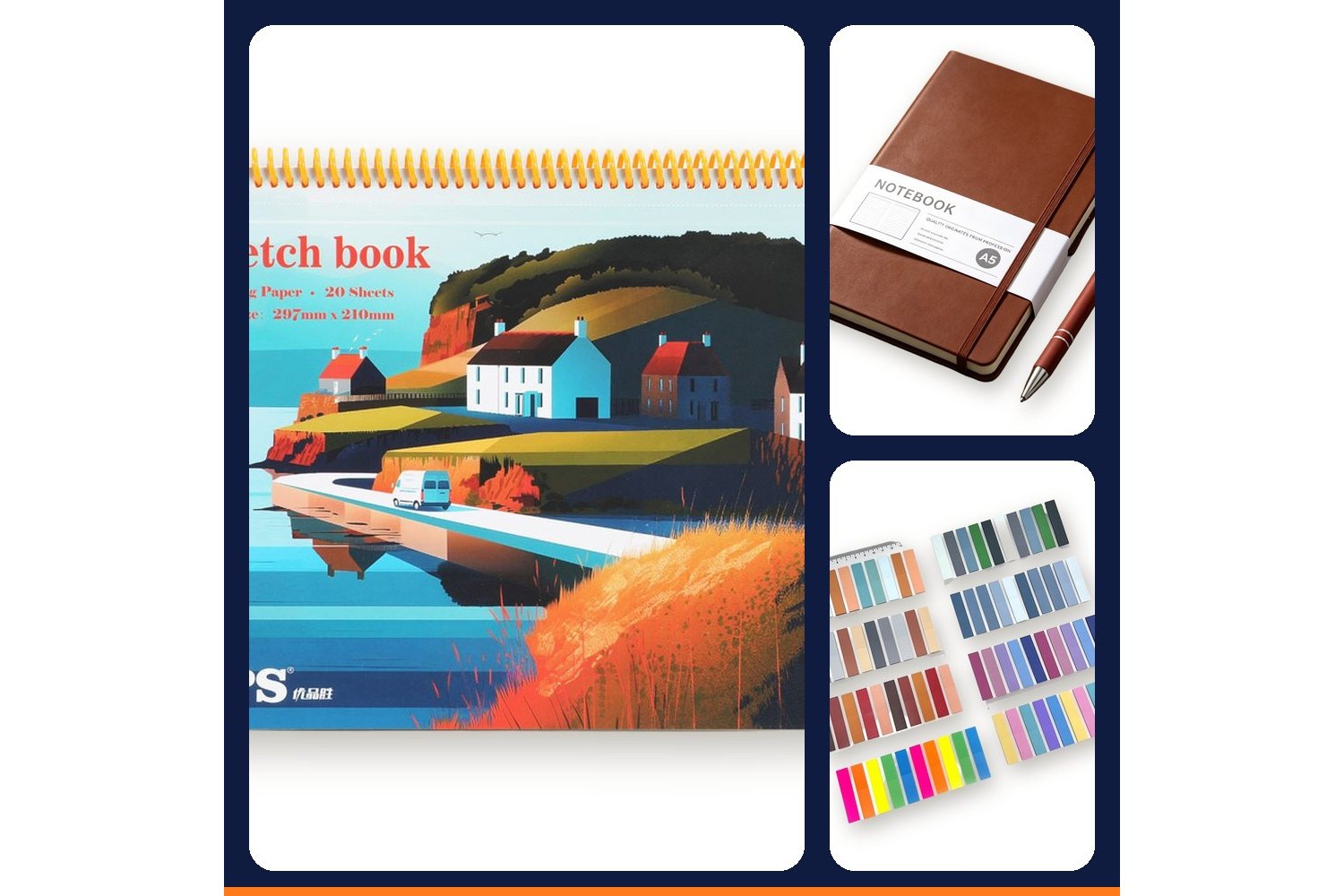
Your own stationery brand does not require your own factory. It usually starts with a ready-made notebook or set that carries your logo, with branded packaging and your own design added later. This route is called private label, and it can be taken in small steps: from a sample to the first batch under your own brand.
In brief
- Stationery is easy to compare on price; your own brand takes the product out of direct comparison and brings repeat purchases.
- Notebooks, diaries, sets, sticky notes and sketchbooks suit branding best: they have a surface for a logo and artwork.
- There are three levels: a logo on a ready-made product, your own packaging, and production to your specification (OEM/ODM).
- At EnjoyCommerce branding is available for more than 8,000 items; it extends the lead time by the artwork and production stage.
- The name is checked and registered as a trade mark – with a national office or with the EUIPO for the whole EU.
Why a brand of your own makes sense in stationery
An unbranded pen, exercise book or folder is a product the customer chooses on price and cannot remember where they bought. Sellers on Amazon, eBay and Etsy know this well: the same item appears in a dozen listings, and the cheapest wins. Your own brand changes the terms: there is only one listing with your name and design, and nothing to compare it with head-on.
The second reason is repeat purchases. Notebooks, planners and sticky notes get used up, and a customer who liked the paper and the cover looks for the same brand again. The third is ranges. Stationery lends itself to collections: one pattern across a notebook, sticky notes, a folder and a cover. The customer takes several pieces at once, and the shop gains a shelf its neighbours do not have.
Finally, a brand helps those who work with corporate customers and schools: notebooks and sets in a consistent design are easier to offer as a ready-made solution than a mixed range from different manufacturers.
Which products suit your own brand
Branding suits products with a visible surface that the customer handles every day. First and foremost these are notebooks and notepads: the cover takes embossing, printing or engraving, depending on the material.

A notebook with the logo embossed on the cover is the shortest route to a first item under your own brand.

A linen cover with custom printing allows artwork of your own rather than just a logo.
The second group is small paper stationery with its own design: sticky notes, page markers, sets on a backing card. Here the brand is above all pattern and shape, and such products round out a range well.

Die-cut sticky notes on a backing card with custom design: the card doubles as ready-made branded packaging.
The third is sets. A notebook with a pen in a shared box is perceived as a gift, and the buyer sees the brand on it rather than the price of the individual pieces.

A notebook and matching pen set with a logo is a ready-made gift item for retail and corporate orders.
Anonymous consumables – paper clips, plain pencils, punched pockets – are less suitable for a start: a logo is barely visible on them, and only the packaging can set them apart.
Three levels: logo, packaging, OEM/ODM
A brand can be introduced in stages, without changing everything at once.
- A logo on a ready-made product. You choose an item from the catalogue and your mark is applied to it: printing, engraving or embossing, depending on the material. The product itself remains standard. This is the basis of the private label service.
- Your own packaging. The logo is joined by a branded box, belly band or backing card and labelling for the target market. The product inside is the same, but on the shelf and in the listing it looks like your own.
- OEM/ODM. Production to your specification: your own format, paper, ruling, cover colours, set contents. The details are on the page about OEM and ODM. This level is justified once the first batches have shown what actually sells.
Each further level requires a larger run and more time. Branding in any form extends the lead time: the artwork stage and production are added to the estimated 20–60 days.
The name and the trade mark
The name of a stationery brand should read easily in small embossing on a cover and in a listing title. A short word works better than a long description. Check how it looks and sounds in the languages of the countries where you sell.
Before ordering artwork, make sure the name is free: search for it in public trade mark databases, among domain names and on marketplaces. A mark can be registered with a national office or with the EUIPO, in which case protection applies across the whole EU. Which classes of goods to include in the application is best discussed with a trade mark attorney.
Do not use names, characters or artwork whose rights belong to others; this applies to popular characters on covers as well. Commission the design with a transfer of rights, or create it yourself.
Packaging and labelling
In stationery, the packaging is often the main carrier of the brand. A notebook gets a paper belly band with the name and specifications, sticky notes get a backing card, a set gets a box. The packaging must make clear what is inside: format, number of sheets, ruling, set contents.
Besides the design, mandatory information is needed on the product or its packaging. Under the EU General Product Safety Regulation (GPSR), the details of the manufacturer and of the responsible person in the EU are stated. If the product falls under separate rules – for example, a set intended for children’s play, which makes it a toy – CE marking is required. Certificates and declarations are requested from the manufacturer before payment.
The texts on the packaging are prepared in the languages of the countries of sale. If you sell in several countries, allow space for several languages from the outset – that is simpler than a separate packaging run for each one.
From sample to batch
- Sample. Choose the items and request a quotation that includes the branding terms. Use a sample of the standard product to check the paper, cover and binding.
- Artwork. Supply the logo in vector format and receive a proof of the branding: size, position, method.
- Approval. Approve the proof, colours and packaging in writing. You then receive a pro forma invoice and pay it by bank transfer in EUR or PLN.
- Production. The batch is made with your branding. The time depends on the method and the size of the run.
- Quality control. Before dispatch the batch goes through a quality check: conformity with the proof, colour, logo position, completeness.
- Delivery. You receive a tracking number and the documents; the cost of delivery within the EU is calculated for the batch.
It is sensible to keep the first branded batch small and limited to two or three items. The minimum order value is EUR 500 net; the minimum run for branding depends on the product and the method and is stated in the quotation.
What the budget is made up of, and typical mistakes
The budget for a brand of your own consists of several items: goods at the net wholesale price, logo application and artwork preparation, packaging design and printing, samples, trade mark registration and attorney fees, delivery of the batch, photography and the set-up of listings or a shelf.
The mistakes made at launch tend to repeat.
- Going straight to OEM. Developing your own product before the first sales ties money up in a run for which demand has not been tested.
- An unchecked name. A run bearing a name already taken by someone else’s trade mark will have to be redone.
- Artwork by eye. A raster logo and unspecified colours produce a result far from what was expected. Approve the proof in writing.
- Deadlines without a margin. Seasonal goods are ordered 2–3 months ahead, and a branded batch adds time for artwork and production.
- One item instead of a range. A single branded notebook gets lost on the shelf; three or four pieces in one design already look like a brand.
Frequently asked questions
What is the minimum run for applying a logo?
It depends on the product and the method. The minimum order value at EnjoyCommerce is EUR 500 net, and the minimum run for branding a specific item is stated by the manager in the quotation.
How long does a batch with a logo take?
The estimated lead time for standard goods is 20–60 days. Branding extends it by the artwork and production stage, so plan batches for the school season and the end of the year with a margin.
Does the trade mark have to be registered before the first batch?
Checking that the name is not already taken is essential, and it must be done before ordering artwork. When to file an application with a national office or the EUIPO is best decided with a trade mark attorney, who will also advise on timing and cost.
Is a custom cover design possible, not just a logo?
Yes. For some items the cover is printed to order, and with OEM/ODM the format, paper and set contents change. The deeper the changes, the larger the run and the longer the lead time.
A stationery brand of your own is built in stages: a logo on a proven product, then packaging, then your own development. Start with two or three items from the Stationery Shops section, register as a wholesale buyer to see prices, and ask for the branding terms. If there is no shop yet, begin with the article on how to open a stationery shop.
