
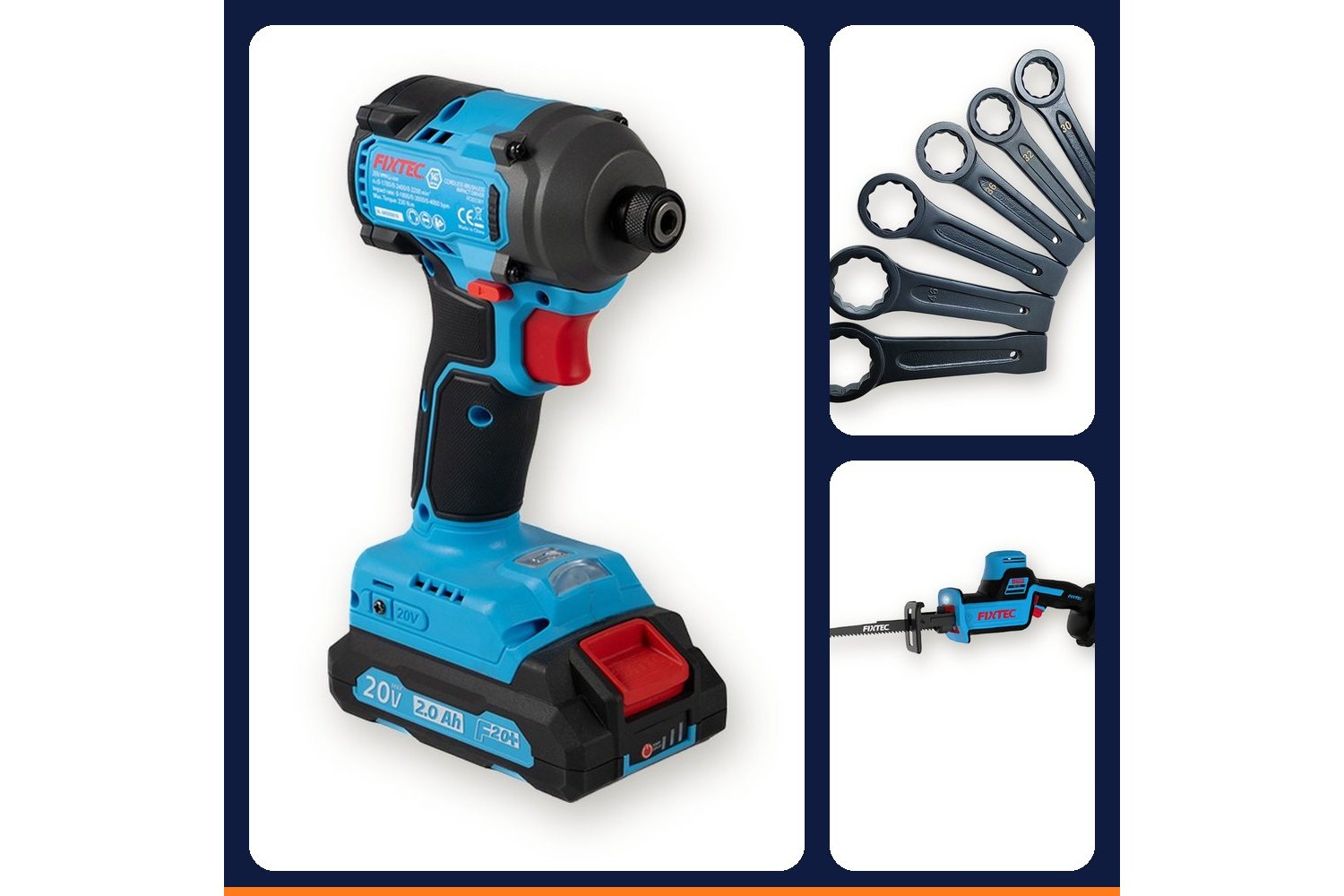
An own tool brand starts not at a factory but with a short line: a few fast-selling items in one colour, under one name and in matching cases. Hand tools and accessory sets are the easiest to launch – a logo and packaging on finished goods. Power tools demand more: a shared battery platform, documents and service. A sensible order is from sets to a cordless line.
In brief
- Start with items that already sell in the shop: bit and socket sets, pliers, screwdrivers.
- There are three levels: a logo on finished goods, custom packaging and case, production to specification (OEM/ODM).
- A tool brand is recognised by the colour of housings and handles – fix it from the first batch.
- For own-brand power tools, declarations of conformity are requested before payment and the rating plate details are agreed.
- The name is checked and registered as a trade mark – at a national office or at the EUIPO for the whole EU.
Why a brand matters in tools
A tool without a name is compared only on price and the figures in the listing. Many sellers offer identical sets and drill drivers, and with equal specifications the cheaper one wins. An own brand takes the product out of direct comparison: no other listing carries that item.
The second reason is the system. Someone who bought a drill driver with a battery chooses the next tool to fit that battery. Accessories and hand tools of the same brand are bought out of habit if the first purchase held up. A line in one colour also works on the shelf: the display looks coherent rather than assembled from leftovers.
The third is the trust of professionals. A tradesperson chooses what can be replaced and topped up quickly. A brand with a stable range, a clear warranty and a contact address gives a reason to return and makes repeat orders easier for crews and companies.
Which products suit an own brand
Cased sets are the most direct route. The logo goes on the lid and the insert, and the contents can be tailored to the shop’s customers. The item is large, visible on the shelf and often bought as a gift.

A compact 38-piece 1/4″ socket and bit set with ratchet: a case with a logo becomes the brand’s showcase.
Hand tools with handles. Pliers, screwdrivers and hammers carry the brand colour on the handle, while the logo is printed or engraved on metal. Multi-function items are easier to tell apart from their neighbours on the shelf.

21-in-1 stainless steel wire stripper pliers: a functional item on which a laser-engraved logo looks natural.
Compact cordless tools are a step between hand tools and power tools: a small product in gift packaging, bought by tradespeople and by those who repair devices at home.

A cordless precision screwdriver with a 52-piece set: a gift format that works well as the first item under an own name.
Cordless power tools are branded once there is demand and a plan for the line: a drill driver, a drill and angle grinders on one battery. What matters is that the next model fits the batteries already sold.

A brushless 20 V impact driver: the base of a cordless line to which further tools are added later.
It is better not to start with items the shop has not yet sold, or with loose consumables: on small fasteners the brand is barely visible.
Three levels: logo, packaging, OEM/ODM
The first level is a logo on finished goods. The method depends on the material: printing on the plastic of housings and cases, engraving on metal, embossing on pouches. Branding is available for more than 8,000 catalogue items; the terms are described on the Private Label page.
The second level is custom packaging: a box, a coloured case, an insert and instructions carrying the brand name. For tools the case is part of the product: it stays with the customer for years and recalls the brand every time.
The third level is production to specification (OEM/ODM): housing colour, set contents, battery kit, an original design. It is justified when demand is steady and it is clear how the version should differ. Each level raises the minimum quantity and the lead time.
Name and trade mark
The name must be legible on a small area: a handle, a rating plate, the side of a case. A short word pronounced the same way across the countries of sale works better than a long descriptive one. Avoid names that resemble well-known tool brands and do not repeat others’ colour combinations – in this category colour itself is an identifier.
Before ordering packaging, check whether the name is taken in the relevant class of goods. A trade mark is registered at a national office or at the EUIPO, in which case protection covers the whole EU. Marketplaces usually ask for proof of brand rights, so the application is filed before listing. A trade mark attorney can advise on timing and classes.
Packaging and labelling
Tool packaging has three jobs. Protection: heavy metal destroys a weak box in transit. Information: set contents, sizes, voltage and kit must be readable from the front. Display: a hang tab for a hook or a stable box for the shelf.
Under the General Product Safety Regulation (GPSR), the product or packaging shows the details of the manufacturer and of the responsible person in the EU. Power tools belong to the categories that carry CE marking, and batteries are covered by separate rules. If the rating plate bears an own brand, clarify in whose name the declarations are issued and obtain them before payment. Instructions and safety warnings are needed in the language of each country of sale. Rules on packaging and waste electrical equipment are national – check them in advance.
From sample to batch
- Sample. Choose the items and ask for a sample or a small trial batch – by agreement with the manager. Test the tool in use: handle grip, play, case latches.
- Artwork. Provide the logo as a vector file, the position, size and method of application, the colour of housing and case, and the packaging texts.
- Approval. The manager confirms options, minimum quantity and lead time with the manufacturer and sends a quotation. Approve the artwork before payment.
- Production. Manufacturing begins once the pro forma invoice is paid. Branding extends the overall time compared with the usual 20–60 days.
- Quality control before dispatch: match with the artwork, completeness of sets, operation of power tools.
- Delivery: the cost is calculated for the batch, and after dispatch a tracking number and documents are sent.
What the budget consists of and common mistakes
The budget of an own brand consists of the goods, set-up for the logo application, packaging and cases, design and texts in the required languages, trade mark registration, delivery and a reserve for warranty replacements. The amounts depend on the item and the run, so the calculation is requested for a specific list.
- Starting with power tools without testing demand on hand tools and sets.
- Changing colour and design from batch to batch – the line stops being recognisable.
- Releasing cordless models whose batteries do not fit one another.
- Ordering packaging before the name has been checked.
- Not planning warranty handling and replacement stock: with a name on the housing, the brand owner answers for quality.
Frequently asked questions
What is the minimum quantity for tools with a logo?
The minimum quantity depends on the item and the method and is stated in the manager’s quotation. The general minimum order is 500 EUR net. A custom housing and case colour requires a larger run than a logo on finished goods.
Can power tools be released under an own brand?
Yes, but the preparation is more serious: conformity documents, rating plate details, instructions in the languages of sale, a warranty procedure. Many start with sets and hand tools and add a cordless line later.
How much does branding extend delivery?
Artwork preparation and approval, plus production to order, are added to the usual time. The manager gives the exact lead time after approval. Plan a seasonal batch – gift sets for December, for example – with a margin.
Must the trade mark be registered before the first batch?
The name should be checked before packaging is ordered. It makes sense to file early: registration takes time, and platforms and partners may ask for proof of rights.
Choose three to five items for the first line in the section of goods for DIY shops and write to the manager about the branding options of interest. If the shop is only being launched, begin with the article on how to open a tool shop.
