
An own electronics brand starts with a narrow task, not with a wish to offer everything for the home. One group of devices, a clearly defined buyer, a name on the housing and the packaging – and responsibility for what stands behind that name: documents, the manual, the warranty. A small seller does well to begin with simple devices without complex software and to extend the line once there are sales and experience in handling customer queries.
In brief
- Start with devices that already sell and are rarely returned: audio, small appliances, accessories for screens.
- There are three levels: a logo on the finished device, custom packaging, production to specification (OEM/ODM).
- In electronics the brand also means a manual in the buyer’s language, the right plug and support that responds.
- If the device carries an own name, establish before payment in whose name the declarations of conformity are issued and who appears on the labelling.
- The name is checked and registered as a trade mark – at a national office or at the EUIPO for the whole EU.
Why a brand matters in electronics
Identical headsets, humidifiers and monitors are sold by dozens of sellers using the same photograph. The buyer sorts them by price, and the one who accepts the lowest margin wins. An own brand takes the product out of that comparison: the item gains its own name, its own listing and reviews that stay with the seller.
The second reason is trust. Unbranded electronics are bought with caution: it is unclear whom to contact if the device stops working. A brand with an address, a manual in the buyer’s language and a clear warranty removes that doubt and reduces returns made just in case.
The third is repeat sales. Someone who liked a headset comes back for a second one or for another device of the same brand. For a business customer – a café, an office, a delivery service – a brand simplifies reordering: the same model is requested rather than a similar one being sought.
Which products suit an own brand
Audio is a frequent first step: a small device, a charging case and a box give enough room for a logo, and the buyer’s need is clear. Work headsets for drivers and call handlers have the advantage of being bought in batches.

A mono Bluetooth headset with ear hook and charging case: logo on the case and the box, and a clear working purpose.
Small appliances for the home and for gifts. Humidifiers, night lights and small devices are bought for their look and packaging – here the brand works through box design and gift presentation.

A mini USB humidifier with night light: a gift item where a branded box matters more than the specifications.
Screens and work equipment. Own-brand monitors and tablets are a step up in difficulty: confirm with the manufacturer whether a logo on the housing and the start-up screen is possible, and check the documents more closely.

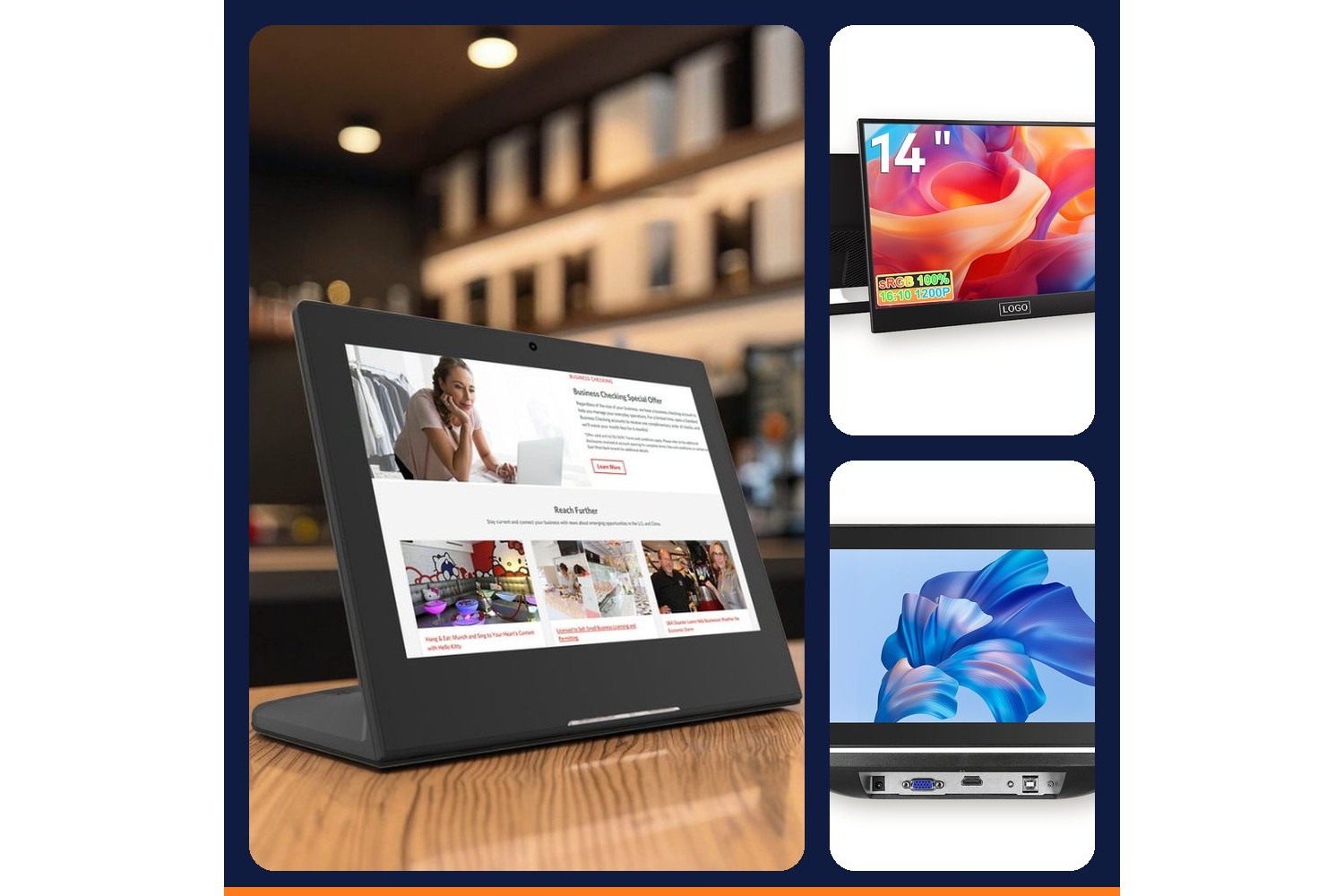
A 14″ portable monitor with USB-C and HDMI, custom logo available: an item for a mobile workplace line.
Devices for business. Desktop tablets, terminals and screens for restaurants and reception desks are ordered in batches for a specific customer – a logo on the housing makes them part of the venue’s equipment.

A 10.1″ Android desktop tablet for restaurants and reception: under the brand of an integrator or a hospitality chain.
Leave projectors, cameras and smart devices with an app for later: there the brand depends on software outside the seller’s control. Items that have not yet sold in the shop are also a poor starting point.
Three levels: logo, packaging, OEM/ODM
The first level is a logo on the finished device: printing or engraving on the housing, case or charging base. The method depends on the material. Branding is available for more than 8,000 catalogue items; the terms are described on the Private Label page.
The second level is custom packaging: a box, an insert, a manual and warranty information with the brand’s name and contact details. In electronics this is already half the impression: a tidy box with a clear connection diagram reduces the number of queries.
The third level is production to specification (OEM/ODM): colour and shape of the housing, kit contents, menu language, start-up logo, an original design. It is justified by steady demand. Each level raises the minimum quantity and the lead time and requires the documents to be checked again for the modified product.
Name and trade mark
The name must be legible at a few millimetres on the housing and easy to type into a search box. A short word without technical abbreviations works better than a long one. Avoid names that resemble well-known electronics brands and do not use others’ names of technologies and standards: the rights belong to their owners, and the terms for using such logos are settled separately.
Before ordering packaging, check whether the name is free in the relevant class of goods. A trade mark is registered at a national office or at the EUIPO, in which case protection covers the whole EU. Marketplaces usually require proof of brand rights. A trade mark attorney can advise on timing and classes.
Packaging and labelling
Electronics packaging protects the device in transit, explains what is inside and carries the mandatory information. The front says what it is and what it is for, the side lists kit contents and specifications, and inside is a manual in the language of each country of sale.
Under the General Product Safety Regulation (GPSR), the product or packaging shows the details of the manufacturer and of the responsible person in the EU. Electronics belong to the categories that carry CE marking and are subject to RoHS restrictions; batteries and radio devices have requirements of their own, and the product bears the separate collection symbol. When goods are placed on the market under an own name, part of the manufacturer’s obligations may pass to the brand owner. So establish with the manager before payment in whose name the declarations of conformity are issued, and show the labelling artwork to a lawyer. Participation in collection schemes for end-of-life equipment and packaging is regulated nationally.
From sample to batch
- Sample. Choose the devices and ask for a sample or a small trial batch – by agreement with the manager. Test for several days: charging, connection, heat, completeness.
- Artwork. Provide the logo as a vector file, the position and method of application, the box design, manual and labelling texts in the required languages, and the plug type.
- Approval. The manager confirms options, minimum quantity, lead time and documents with the manufacturer and sends a quotation. The artwork is approved before payment.
- Production. Manufacturing begins once the pro forma invoice is paid. Branding extends the overall time compared with the usual 20–60 days.
- Quality control before dispatch: match with the artwork, operation, kit contents, labelling.
- Delivery: the cost is calculated for the batch, and after dispatch a tracking number and documents are sent.
What the budget consists of and common mistakes
The budget consists of the goods, set-up for the logo application, packaging, design, translation of manuals, trade mark registration, delivery and a reserve for warranty replacements. A separate item is a legal review of labelling and documents. The amounts depend on the device and the run, so the calculation is requested for a specific list.
- Starting with a complex app-based device without experience in support.
- Applying a logo without establishing whose name is in the declarations and on the labelling.
- Saving on the manual and receiving returns of working devices.
- Keeping no replacement stock: under an own brand, the owner answers for every device.
- Ordering packaging before the name has been checked.
Frequently asked questions
What is the minimum quantity for electronics with a logo?
The minimum quantity depends on the device and the method and is stated in the manager’s quotation. The general minimum order is 500 EUR net. Custom packaging and changes to the device require a larger run.
Can an own logo appear on the start-up screen or in the menu?
For some devices the manufacturer offers this, but such a change belongs to the OEM/ODM level: a larger batch and extra time are needed. Check for the specific model.
Who is responsible for the warranty under an own brand?
The seller is responsible to the buyer – and when the goods carry the seller’s name, that is where claims arrive. Describe the procedure in advance, keep replacement stock and agree the handling of defective goods with the manager before ordering.
How much does branding extend delivery?
Artwork, its approval and production to order are added to the usual time. The manager gives the exact lead time. Plan a batch for December from early summer.
Choose one group and three or four devices in the section of goods for electronics shops and write to the manager about the branding of interest. If the shop is only being launched, begin with the article on how to open an electronics shop.
