
A manufacturing company has two routes to a brand. The first is to make goods under its own name and answer to the buyer directly. The second is to act as a contract manufacturer, producing for other brands to their requirements. The routes are not mutually exclusive, and both need the same things: consistent quality, well-planned packaging, correct labelling and clear trade mark rights. Below: how to build this and what can be ordered on an OEM/ODM basis.
In brief
- Your own brand gives control over price and sales; contract work fills capacity. Many workshops combine the two.
- Under your brand you can not only make your own products but also order machinery, workwear and packaging.
- Three levels: logo on a finished product, branded packaging, production to your requirements.
- The name is checked and filed as a trade mark before packaging is printed – with a national office or with the EUIPO for the whole EU.
- Branding lengthens delivery time: artwork, approval and production are added.
Why a manufacturer needs its own brand
Unnamed goods are compared on price alone. A brand on the product, the packaging and the paperwork lets the buyer come back to you specifically and gives a distributor a reason to stock your goods. For a subcontract workshop, a brand is also protection against dependence on one or two large customers.
Contract manufacturing solves a different problem: it keeps machines busy between your own runs. The client – a retailer, an Amazon seller, a chain – brings volume and a brand; you are responsible for process and deadlines. Reputation here comes not from a logo but from repeatability: the same result in every batch and careful labelling to the client's requirements.
There is a third layer – the brand of the business itself: workwear with a logo, marked equipment and containers. It does not change product quality, but a client visiting for an audit sees order.
What you can produce and brand
Four groups of goods and equipment work under a manufacturer's brand.
Your own products. What you make on your own machine tools to your own drawings. Build the logo into the product itself – engraved, milled or on a nameplate – so that it does not disappear with the packaging.

A CNC router: series parts to your drawings and a logo engraved directly on the product.
Filling and packing under the client's brand. Contract filling is a familiar model in beverages. It needs production lines that can be changed over to the client's container and label. Food production requires permits under national rules, and for equipment in contact with the product you should request material documents before payment.

The monoblock combines rinsing, filling and capping – the core of a contract filling station.
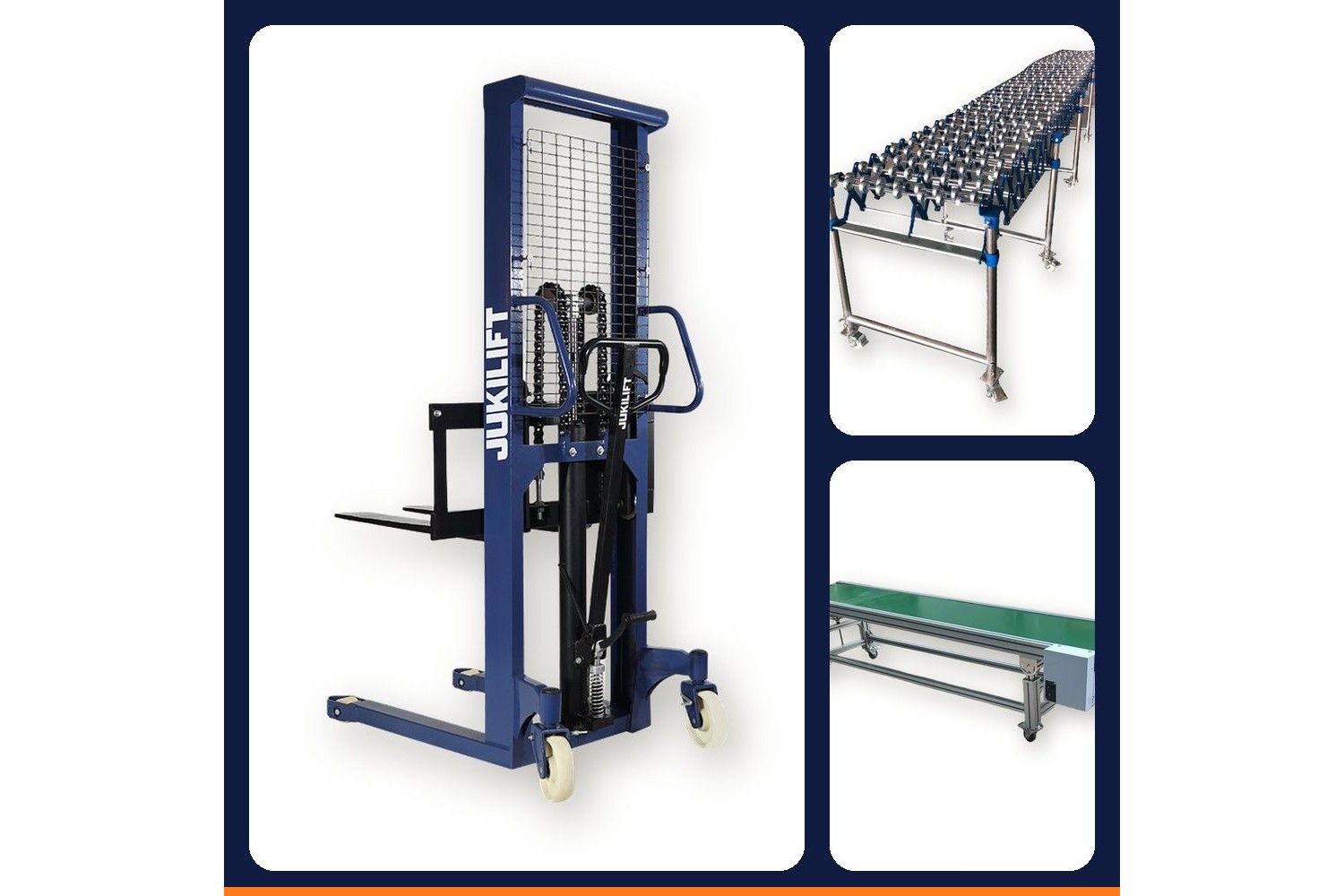
Packing and labelling area. This is where the brand reaches the goods: label, carton, insert, pallet label. Conveyors link packing stations into a flow and reduce the risk of mixing up batches for different clients.

A belt conveyor feeds items to labelling and packing stations, with less carrying by hand.
Equipment and workwear under your name. Dealers and service companies order equipment on an OEM basis – in house colours, with a nameplate and logo. Whoever places a machine on the market under their own name takes on the manufacturer's obligations, so discuss the documents with the manager and a lawyer in advance. Workwear with a logo is ordered both for your own staff and as branded merchandise.

A manual stacker is everyday warehouse equipment; ask the manager whether a version under your brand is possible.
Three levels: from logo to OEM/ODM
Logo on a finished product. The quickest entry: printing, engraving or embossing, depending on the material. It suits workwear, tools, accessories and goods that complement your own range. The terms are on the Private Label page.
Your own packaging. Box, label, instructions and insert in your house style, with labelling for the target market. The product inside is standard, but on the shelf and in an Amazon listing it is already yours.
OEM/ODM. Production to your requirements: OEM follows your specification or drawings; ODM adapts the manufacturer's existing design to your brand. Choose this level when you need to extend your range with items that are not worth making in-house, or need a machine in a particular configuration. Branding is available for more than 8,000 catalogue items.
Name and trade mark
Check the name before it reaches nameplates and cartons: is it free in your classes of goods, how does it read in the languages of your markets, is the domain available? A trade mark is registered with a national office if the market is one country, or with the EUIPO for the whole EU at once. Registration takes time, so the application is filed in parallel with preparing the first batch.
A contract manufacturer sees the other side: the mark belongs to the client, and the contract should say so. It should also state who owns tooling, moulds and artwork, how documentation is kept, and what happens to overruns and rejects bearing the client's logo. Ask the client to confirm their rights to the mark: goods bearing someone else's sign must not be made without the owner's consent.
Packaging and labelling
Packaging has three jobs: to arrive undamaged, to convey mandatory information and to show the brand. Under the EU General Product Safety Regulation (GPSR), a consumer product or its packaging carries the manufacturer's details and, for goods from outside the EU, those of the responsible person in the EU. Categories subject to CE marking – machinery, electrical equipment, protective equipment – need the CE mark, a declaration of conformity and instructions in the language of the country of sale. Request certificates and declarations from the manager before payment.
In contract work, agree in advance whose details go on the label, who is responsible for texts and translations, and how the batch and date are marked. A batch number on the product and the carton is the basis of traceability: in a complaint you can find the affected run instead of checking everything.
From sample to batch
- Sample. A sample or a small trial batch is available by agreement with the manager. Test the product in use, not just by appearance.
- Artwork. Prepare a vector logo, colours, labelling texts in the required languages and, for OEM, a specification or drawings.
- Approval. Approve the branding proof, packaging, configuration and documents; for machines, also voltage, number of phases and the spare parts set.
- Production. Once the pro forma invoice is paid, the batch goes into production. Artwork and production lengthen the lead time compared with stock goods.
- Quality control. Before dispatch the batch passes a quality inspection: conformity to the sample, branding, packaging, labelling.
- Delivery. An estimated 20–60 days to any EU country; after dispatch you receive a tracking number and documents.
What the budget consists of, and typical mistakes
The cost of a brand covers the name and visual identity, trade mark registration, artwork and branding set-up, tooling for OEM, samples, the first batch with delivery, packaging and printing, and documents and testing where the category requires them. The minimum order value is EUR 500 net; the unit price depends on the run size and branding method.
- Printing packaging before checking the name and filing the trade mark.
- Starting with OEM where a logo on a finished product would have been enough.
- Working on contract without an agreement on trade mark rights, tooling and overruns.
- Leaving no time for artwork and approval – and missing the season.
- Incomplete manufacturer details on the label, or text not in the language of the country of sale.
- Approving a batch from a photograph without testing the sample in use.
Frequently asked questions
From what quantity is branding possible?
It depends on the product and the method. Many items have a minimum quantity of 1–10 units, but for branding and custom packaging the manufacturer may set its own minimum. The manager states the exact terms in the quotation.
Can machinery be ordered under my own brand?
This is agreed case by case: colour, nameplate, logo, configuration, documentation. Bear in mind that with your name on the machine you take on the manufacturer's obligations, so agree the documents and the split of responsibility before payment.
How does OEM differ from ODM?
OEM is a product to your specification: you set the design and requirements. ODM is the manufacturer's existing development adapted to your brand. ODM is simpler at the start; OEM gives a product that others do not have.
How much does branding add to the lead time?
On top of the estimated 20–60 days come artwork preparation and approval and production of the batch. The exact time depends on the product and is stated in the quotation; for seasonal demand, order 2–3 months ahead.
Start small: a logo on workwear and packaging, one or two items under your own brand, then OEM. Machinery and equipment are in the Manufacturing Companies section; questions about custom orders go through the contact page. For equipping a workshop from scratch, see the article How to start a small manufacturing business.
