
A seasonal shop starts with a calendar rather than a shop window: which holidays you serve and when the stock for each has to be ordered. Sales come in short waves – Christmas and New Year, Easter, Halloween – and the year-round lines keep the shop going in between. That leaves three decisions at the start: the list of seasons, how deep to buy for each, and where leftover stock will sit until next year.
In brief
- The plan rests on an annual calendar: for each holiday, an order date, a display date and a markdown date.
- Seasonal goods are ordered 2–3 months ahead; the indicative delivery time is 20–60 days.
- The first order for each season should be shallow: more lines, fewer units per line.
- Leftovers are inevitable: decide in advance what is stored until next year and what is cleared straight away.
- Between holidays, candles, LED decorations and goods for family occasions carry the sales.
Customers and format
There are three types of customer. Families decorate their homes and buy in the last weeks before the holiday, often in passing and without a list. Organisers – schools, nurseries, cafés, offices, entertainers – buy in quantity and come earlier: they need matching decorations for a hall or a window. The third group looks for a small gift or a costume detail just before the date.
There are several formats. A permanent shop changes its display four or five times a year and keeps a year-round section. A temporary outlet – a kiosk in a shopping centre or a stall at a Christmas market – runs for a few weeks and needs a precisely calculated quantity: once it closes, there is nowhere to sell the remainder. An online shop or a marketplace such as Amazon, eBay or Etsy lets you start without rent, but timing matters there: listings must be live before demand begins and the parcel must arrive before the date. Business customers need an invoice and predictable delivery.
Starting range: core lines and trial lines
Christmas and New Year form the longest and largest wave. Core groups: artificial trees, baubles and hanging ornaments, garlands, figurines and gift packaging. Large trees take up a lot of space in transit and in storage, so tabletop models are an easier place to start.

Tabletop tree, 45 and 60 cm, with ornaments and lights: a ready-made option for offices, cafés and small flats.
Advent calendars sell earlier than everything else – up to the start of December – and demand stops after that. Order them cautiously and put them on display first.

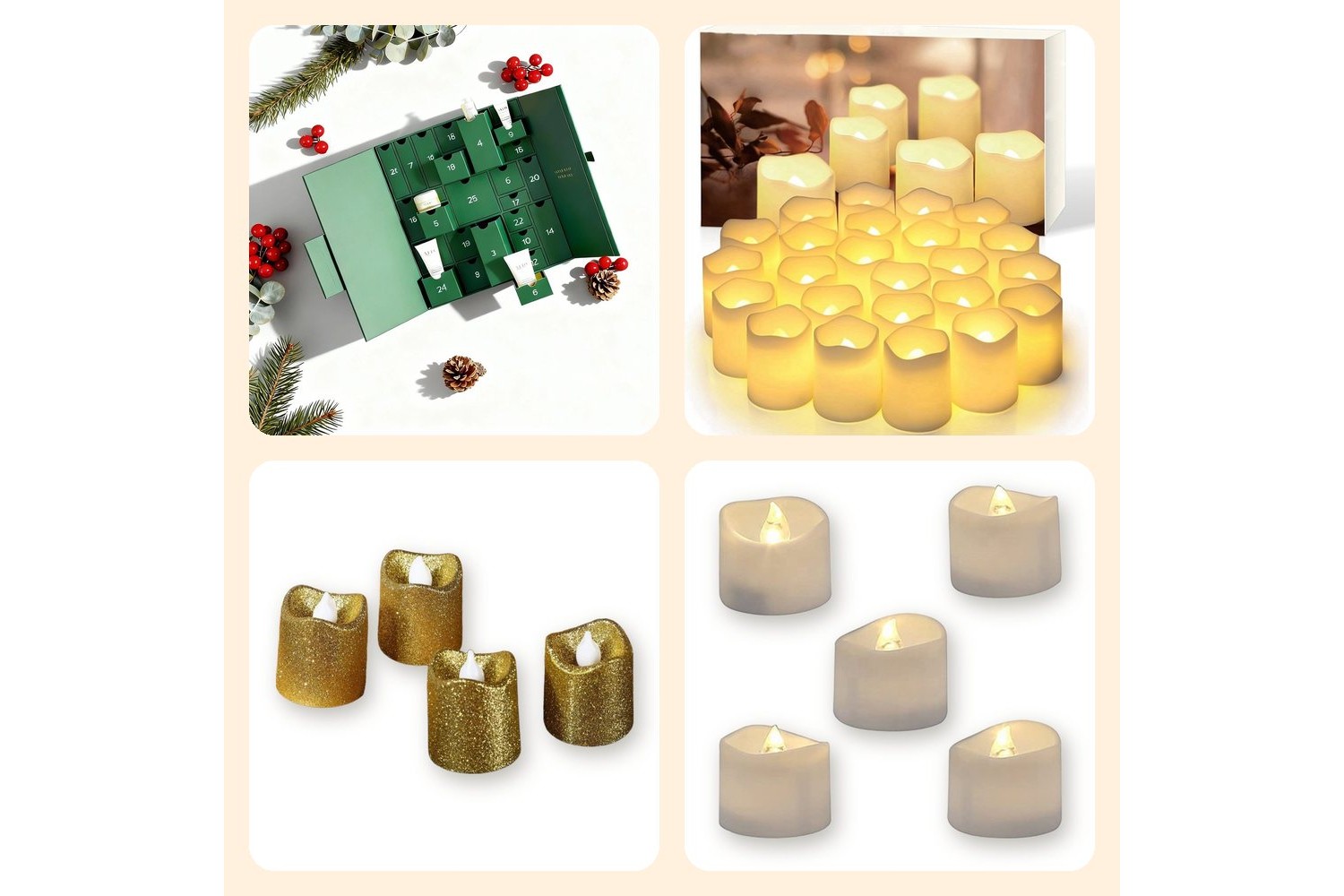
Advent box with doors and drawers: the base for a set of your own, filled by the shop itself.
Halloween is a short season that peaks in the last week of October. The range has two parts: Halloween props for decorating the house, garden and venue, and Halloween clothing and decorations – costumes, masks, accessories. Costumes come in sizes, and odd sizes left over sell poorly; buy few of them for the first season and be bolder with props and lighting.

Pumpkin and spider web LED tea lights: an inexpensive Halloween line that customers buy several at a time.
Easter is the spring wave with a movable date, so the order day is recalculated every year. The sellers here are Easter decorations – hanging ornaments, wreaths, decorative eggs – and Easter bunnies as figurines and soft toys. The goods are light, compact and easy to store.
The year-round section stops the shop standing empty between dates. LED candles are bought for homes, terraces, cafés and events at any time of year; goods for birthdays and family occasions belong here too.

Set of 6 rechargeable LED candles with remote and timer: sells all year and is not tied to a single date.
How to spread the range across the year is covered in more detail in the article on building a range around the holiday calendar.
What the starting budget consists of
The particular feature of this niche is that money goes out long before sales and comes back within a few weeks. The stock budget is calculated by season:
- the consignment for the nearest holiday – the largest item;
- payment for the following season, made before the current one has sold;
- the year-round group that brings in revenue between waves;
- delivery, which is calculated per consignment: bulky trees and figures cost differently to ship than small decorations;
- storage: shelving, cartons, a warehouse or stockroom for the months between seasons;
- a reserve for marking down leftovers after the holiday.
Retail rent, registration, a till and advertising are budgeted separately.
Supplier and first order
EnjoyCommerce supplies goods to companies and sole traders in EU countries. The minimum order value is 500 EUR net per item, so a trial season can be put together as one order of several items, each from 500 EUR net.
- Read the buyer's guide and complete wholesale registration: after that, net prices by volume tier become visible.
- Draw up a list for the season: item, size, colour, quantity – and state the date by which the goods must be on the shelf. A manager will prepare a quotation and calculate delivery for the consignment.
- Approve the quotation and receive a pro forma invoice. Payment is by bank transfer in EUR or PLN.
- The goods are dispatched or manufactured and go through quality control before shipping. Ask for the lighting, the completeness of sets and the packaging to be checked.
- After dispatch you receive a tracking number and documents. Check the delivery terms against your calendar: the indicative lead time is 20–60 days.
Invoices are issued by a Polish company with an EU VAT number. For EU companies with a valid EU VAT number, an intra-Community supply (reverse charge) is possible; your accountant will advise how to record it.
Documents and product requirements
Business registration, taxes and the rules for temporary trading at markets depend on the country and the town – check them with an accountant and the local authority. Product requirements are common across the EU. Under the General Product Safety Regulation (GPSR), the product or its packaging carries the details of the manufacturer and of the responsible person in the EU.
String lights, LED candles and illuminated figures are electronics: they need CE and RoHS documentation, and items with batteries or rechargeable cells have requirements of their own. Soft toys and goods intended for children's play fall under toy safety rules and CE marking; whether that applies to a particular children's costume or mask is something to clarify with the manager. Request certificates and declarations before payment.
Seasonality and the ordering calendar
Count backwards from the display date. Christmas and New Year stock should be in the shop in October or early November, so the order is placed in summer. Halloween stock needs to be on the shelf in September and is ordered at the start of summer. The Easter consignment is ordered in late autumn or early winter, at the height of Christmas trading. Preparations for Valentine's Day and carnival take place in autumn.
The general rule is to order 2–3 months before display, and earlier still for branded goods. Draw up a calendar for the year: for each holiday, the dates of the enquiry, payment, expected arrival, display and first markdown.
The second half of the calendar is leftover stock. Neutral decorations with no year and no passing theme – baubles, garlands, LED candles, figurines – will wait for the next season without trouble if packed in labelled cartons and kept somewhere dry. Goods carrying a date or the theme of a single year are better cleared at once, and batteries are removed from illuminated items before storage. Count the remainder before putting it away: next year's order starts from that figure.
Typical mistakes at the start
- Ordering a month before the holiday and receiving the goods after the date.
- Buying one line in a large quantity instead of a broad range in small quantities.
- Not planning the space and cost of storage between seasons.
- Holding the full price until the last day: after the holiday, goods sell only at a deep markdown.
- Leaving the shop without a year-round group and without revenue between waves.
Frequently asked questions
What is the smallest amount to start buying with?
The minimum order value is 500 EUR net per item. It can be a combined consignment for one season, each item from that amount.
Which holiday should come first?
The one that is far enough away: 2–3 months are needed from enquiry to display. If the nearest date is closer than that, prepare the following season and launch the year-round group in the meantime.
What should be done with leftovers after the holiday?
Split them in two. Pack neutral goods and store them until next year, counting them into the new order. Mark down themed, dated and fragile goods in the first days after the holiday, while there is still demand.
Can a trial consignment be ordered before a large purchase?
A sample or a small trial consignment is available by agreement with the manager. A trial takes time too, so for seasonal goods it is ordered well ahead.
Draw up the calendar, choose two or three seasons for the first year and select items in the section of goods for seasonal holiday shops. Once some lines sell year after year, they can be released under your own name – see the article on your own brand of seasonal goods.
