
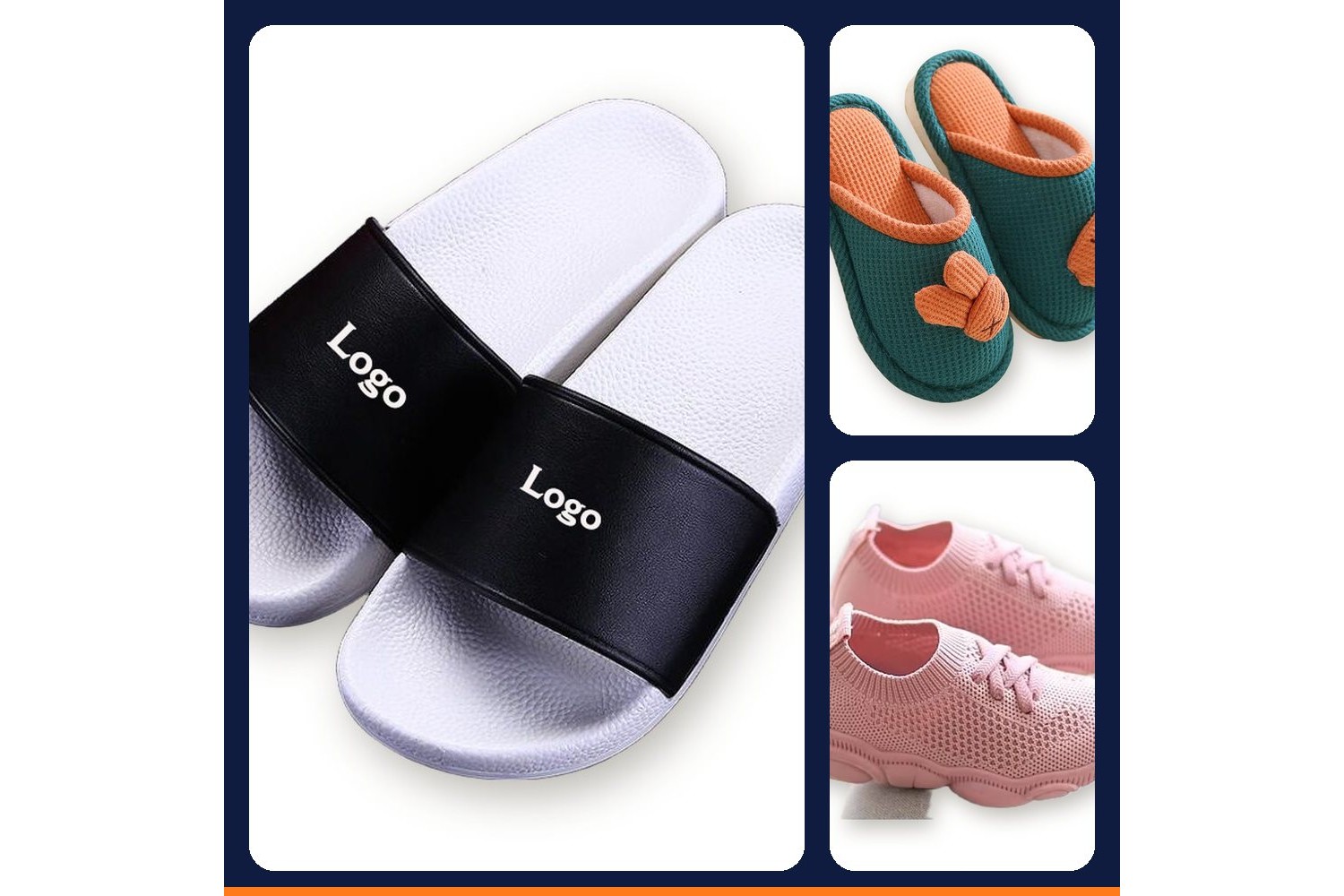
The easiest way to start your own indoor footwear label is not with a factory but with a logo on a ready-made model. Slippers and slides have convenient places for a mark – the strap, the insole, a sewn-in label – and packaging turns an inexpensive pair into a gift. A separate side of the niche is orders from hotels, spas and companies that need slippers with their own branding. Below: which models to choose, how the three levels of branding differ and how to get from sample to batch.
In brief
- Start with a logo on a ready-made model; your own packaging and label come second, your own last and materials third.
- The decoration method depends on the material: printing and embossing on PVC, embroidery and patches on textiles.
- A brand in this niche works in two directions: your own label for retail and slippers under the customer’s brand – a hotel, spa or company.
- The size chart is fixed in the specification in centimetres: returns and the label’s reputation depend on it.
- Branding extends the lead time, so the winter line goes into work in spring.
Why a brand in this niche
The first reason is escaping price comparison. Many sellers offer identical unbranded slippers, and on a marketplace the buyer picks the cheapest pair. A model with its own mark, label and packaging has nothing to be compared with directly.
The second reason is gift demand. Warm slippers are often bought as presents, and a present is chosen by its look: the box, the swing tag and the brand name influence the decision as much as the pair itself.
The third reason is repeat purchases. Indoor footwear wears out, and if the pair was liked, the buyer looks for the same label again. With unbranded goods there is nothing to come back to.
The fourth reason is business orders. Hotels, holiday lets, spas and gyms order guest slippers with a logo; companies order pairs for events and staff gifts. Once your decoration process runs smoothly, such orders become a second channel alongside retail.
Which products suit your own label
Choose models without third-party decoration and with an even surface for the mark.
PVC slides. The wide strap is a ready-made area for a logo, printed or embossed. One model in several colours gives a line for home, pool and travel, and a base for hotel and club orders. Models are in the ‘Slippers’ category.

Men’s PVC slides designed for logo application – a ready base for the first line under your own label.

Promotional slides printed with the customer’s logo – a model for orders from hotels, clubs and companies.
Textile slippers. The mark is embroidered on the upper, added as a woven label on the side or printed on the insole. Knitted and fleece models look good in gift packaging and suit a women’s or family line. See the ‘House shoes’ category.

Soft knitted ballerina slippers: with a woven label and a box they become the label’s gift item.
Animal-shaped models and those with large appliqués are less suitable: the mark gets lost on them and the brand has to move to the swing tag and packaging.
Three levels: logo, packaging, OEM/ODM
Logo on a ready-made model. You choose the model, colours and sizes, and the manufacturer applies the mark; the method is matched to the material. This is the fastest route and a convenient test of demand. The terms are set out on the Private Label page; branding is available for more than 8,000 catalogue items.
Your own packaging and label. A sewn-in label with the brand name, a swing tag, a branded bag or box, labelling for your market. From this point the pair looks like a branded product rather than slides with a print.
OEM/ODM. Production to your requirements: the shape and thickness of the sole, upper and lining materials, colour matched to a sample, your own size chart. Move to this level when the core line is selling and it is clear what ready-made models lack. Details are on the OEM/ODM production page.
Name and trade mark
A name for indoor footwear should be short: the strap and the label are small, and a long word becomes an unreadable line. Make two versions of the mark – a full one for the box and tag and a simplified one for the pair itself – and check how it looks in one colour and as blind embossing.
A trade mark is registered with a national office or with the EUIPO for the whole EU. Footwear falls in the same class as clothing and headgear, and that class holds many existing marks, so search the open databases before ordering the first batch. The procedure and cost depend on the office; if in doubt, consult a trade mark attorney.
Packaging and labelling
For the retail shelf, a swing tag or a card band holding the pair together is enough: it carries the name, size and barcode. A gift line needs a box or pouch. For online sales, a sturdy bag and a clearly printed size matter – this helps avoid warehouse errors. Guest slippers for hotels are usually packed in pairs in an individual bag with the venue’s logo.
The product or packaging must carry the details of the manufacturer and of the responsible person in the EU, as the General Product Safety Regulation requires. Footwear is sold with labelling of the upper, lining and outer sole materials, as pictograms or as text in the language of the country of sale. If the pair carries your brand, customers and authorities turn to you, so ask the manager for the material composition and documents before payment.
From sample to batch
- Sample. A sample or a small trial batch is arranged with the manager. Check the fit, insole length for each size, sole stiffness and the smell of the material.
- Artwork. Prepare the logo as a vector file, specify the position, size and colour of the decoration, and attach the packaging and label artwork.
- Approval. The manufacturer sends a visual or photo of the pair with the decoration. Check the colours, the position of the mark and the size chart – corrections are still cheap at this stage.
- Production. After approval and payment of the pro forma invoice, the batch goes into production. The artwork and production stage extends the overall lead time.
- Quality control. Before dispatch the batch is checked: decoration, pairing, sizes, packaging. How this works is explained on the quality control page.
- Delivery. After dispatch you receive a tracking number and documents; the terms are on the delivery page.
What the budget consists of and typical mistakes
A brand budget consists of the batch of goods, decoration, packaging and labels, logo and artwork design, trade mark registration, delivery and photography. The more sizes and colours in the line, the more money sits in stock, so it is sensible to limit the first batch to one or two models.
- Launching many models at once: each one is multiplied by sizes and colours.
- Not fixing the size chart in centimetres – and receiving a batch that runs small.
- Approving artwork from a screen image without seeing the decoration on the material.
- Putting the name on a batch before checking the trade mark.
- Forgetting lead times: a branded winter line ordered in autumn arrives after the season.
Frequently asked questions
What batch size can you start with?
The minimum order value is 500 EUR net. The minimum quantity for decoration depends on the model and the branding method; the manager states it in the quotation.
Which decoration method should you choose?
Printing and embossing suit PVC; embroidery, a patch or a woven label suit textiles. The final option is matched to the material of the specific model; ask to see an example of the decoration before the batch starts.
Can slippers be made under a hotel’s brand?
Yes. The venue sends its logo and wishes on colour and packaging; you agree the artwork and place the order. It is practical to offer one or two universal models and state the lead time up front: with branding it is longer than usual.
How much does branding add to the lead time?
The artwork approval and production stage is added to the indicative 20–60 days. The exact time depends on the model and volume and is stated in the quotation, so plan a seasonal line with a margin.
Start small: register as a wholesale buyer, choose one model in the ‘Slipper Shops’ section and ask for the decoration terms. If the shop is still at the planning stage, first read the article ‘How to open a slipper shop’.
