
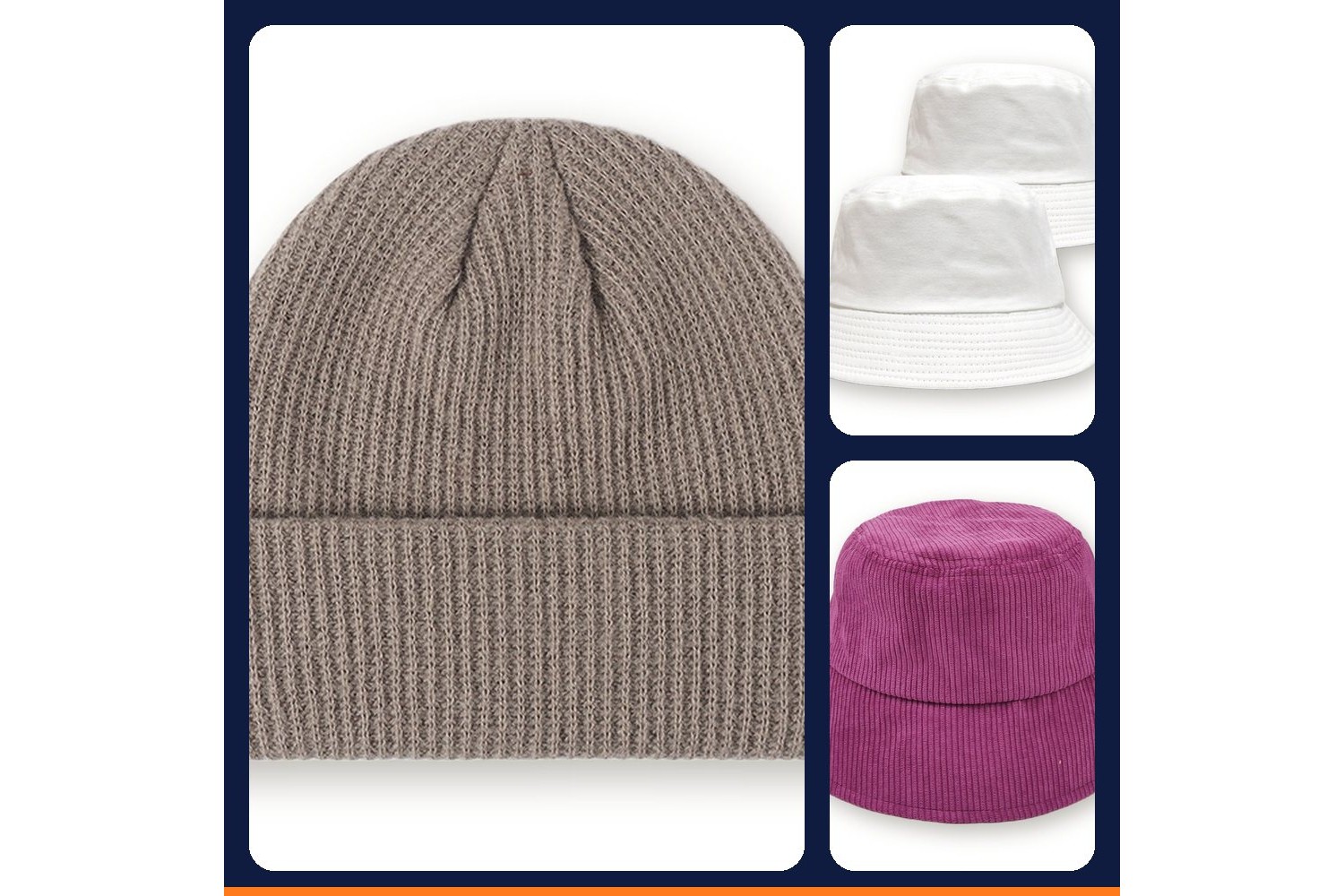
Headwear is one of the simplest ways into an own clothing brand. It has no long size run, the place for the mark is in plain view – on the front panel of a cap or the cuff of a beanie – and the catalogue offers plenty of finished models for branding. Here the brand starts not with a factory but with a logo on a suitable base model. Below: which products to choose, how the three levels of branding differ, and how to get from sample to batch.
In brief
- Start with a logo on a finished cap, bucket hat or beanie; own label and packaging are step two, own cut is step three.
- The method depends on the product and material: embroidery, printing, a patch.
- A logo for embroidery must be simple: thread cannot reproduce fine lines and small text.
- Clothing and headwear fall into the same trade mark class; the name is checked before ordering a batch.
- Branding extends the lead time, so the winter collection goes into work in spring or early summer.
Why a brand in this niche
The first reason is visibility. Headwear is worn at eye level and everyone around sees the mark: every customer becomes a carrier of the brand. Few products give a logo such a position.
The second reason is escaping price comparison. Identical unbranded baseball caps and beanies are sold by many, and on Amazon or eBay the buyer simply picks the cheapest. A model with its own mark and label has nothing to be compared with directly.
The third reason is simple logistics. Most models come in one adjustable size, so a batch is split by colour rather than size, and the risk of slow-moving leftovers is lower than in clothing.
The fourth reason is business orders. Clubs, cafés, schools and event organisers order headwear with their own emblems. Once branding runs smoothly, these orders become a second sales channel alongside retail.
Which products suit an own brand
Choose base models without third-party decoration: the calmer the product, the better your mark reads on it.
Caps. The main area is the front panel: embroidery or a patch. Additional areas are the side and the zone above the rear strap. On 5-panel models the front panel is one piece with no centre seam, which suits a wide logo. Models are in the Baseball caps category.

A 5-panel cap with a one-piece front panel: it takes a wide logo with no seam down the middle.
Bucket hats. The mark goes on the front of the crown or on a small woven label at the side. Cotton takes both printing and embroidery. See the Bucket hats category.

A cotton bucket hat made for logo printing and embroidery is a ready base for a summer line and promotional orders.
Knitted beanies. The place for the mark is the cuff: a patch or a woven label. A wide colour range in one model makes it possible to build a line of several colours with a single mark. Category: Hats and beanies.

A ribbed cuffed beanie in ten colours: one model, one mark on the cuff, and a colour line is ready.
Three levels: logo, packaging, OEM/ODM
Logo on a finished product. You choose the model and colours and the manufacturer applies the mark; the method is chosen to suit the material. This is the fastest route and a convenient demand test. The terms are on the Private Label page; branding is available for more than 8,000 catalogue items.
Own label and packaging. A sewn-in label with the brand name, a swing tag, a branded bag or box, labelling for your market. From this point the product looks like a brand item rather than a cap with embroidery.
OEM/ODM. Production to your requirements: cut, fabric, colour matched to a sample, peak shape, knit pattern. This level follows once the base line is selling and it is clear what the finished models lack. Details are on the OEM/ODM production page.
Name and trade mark
A name for headwear should be short: the branding area is small, and a long word turns into an unreadable line. Make two versions of the mark – a full one for the swing tag and packaging and a simplified one for embroidery – and check how it looks in a single colour and at small size.
A trade mark is registered with the national office or with the EUIPO, which covers the whole EU. Clothing and headwear fall into the same class, which contains many existing marks, so a search of public databases is best done before ordering the first batch. The procedure and cost depend on the office; if in doubt, consult a trade mark attorney.
Packaging and labelling
For the retail shelf, a swing tag and a neat sewn-in label are enough. Online sales need a bag or box in which the peak will not be crushed in transit, and space for a barcode. Gift and corporate orders use a branded box.
Labelling is the brand owner’s responsibility. For textile products, the label states fibre composition in the language of the country of sale; care symbols and the size or head circumference are customarily added. Under the EU General Product Safety Regulation, the product or packaging must show the manufacturer and the responsible person in the EU. If the line includes children’s models, take into account the safety requirements for children’s clothing, including those for cords and drawstrings. Ask the manager for composition and documents before payment.
From sample to batch
- Complete the wholesale registration and send a request: models, colours, quantities, branding method and position.
- A sample or a small trial batch – by agreement with the manager. Assess the fit, the density of the fabric or knit, and the colour in real life.
- Prepare the artwork: vector logo, size in millimetres, thread or print colours, label and swing tag designs.
- Approve the artwork and the quotation. A pro forma invoice and payment by bank transfer in EUR or PLN follow.
- Production: sewing or picking the items, branding, labels, packaging.
- Quality control before shipment: position and evenness of the embroidery, colour, completeness.
- Dispatch and tracking number. The indicative lead time is 20–60 days plus time for artwork and production; the terms are on the delivery page.
What the budget consists of and typical mistakes
The brand budget has several parts: the items themselves, logo application, labels and swing tags, packaging, development of the mark and artwork, trade mark registration, delivery per shipment, and photography on a model. The minimum order is EUR 500 net; the unit price depends on the quantity tier. Plan the first batch as a test: two or three models in a few colours.
What to avoid:
- a complex logo with gradients and small text – embroidery will not reproduce it;
- launching two seasons at once: start with the nearest one;
- ordering a batch without a sample and approved artwork;
- a mark that resembles well-known brands or club emblems;
- too wide a palette in the first batch: bright colours stay in the stockroom;
- a late start: October is too late to order a branded winter line.
Frequently asked questions
Which is better for a logo – embroidery or printing?
Embroidery looks raised and lasts well but requires a simple mark. Printing reproduces fine detail and suits smooth cotton. For knitted beanies, a patch or woven label is the usual choice. The manager will advise on the method for a specific model.
What quantity is enough to start?
Many items start from 1–10 pieces, but branding terms depend on the model and method and are confirmed in the request. The overall order starts at EUR 500 net.
Can one model in several colours serve as a line?
Yes, this is the simplest way: one base model, one mark, several colours. The customer sees a collection, and you need only one artwork.
When should winter and summer collections be launched?
Seasonal goods are ordered 2–3 months ahead, and the artwork stage comes on top. Work on a winter line starts in spring, on a summer line in autumn.
Choose two or three base models in the Headwear shops section, simplify the mark for embroidery and start with a small batch. If there is no shop yet, first read the article How to open a headwear shop.
