
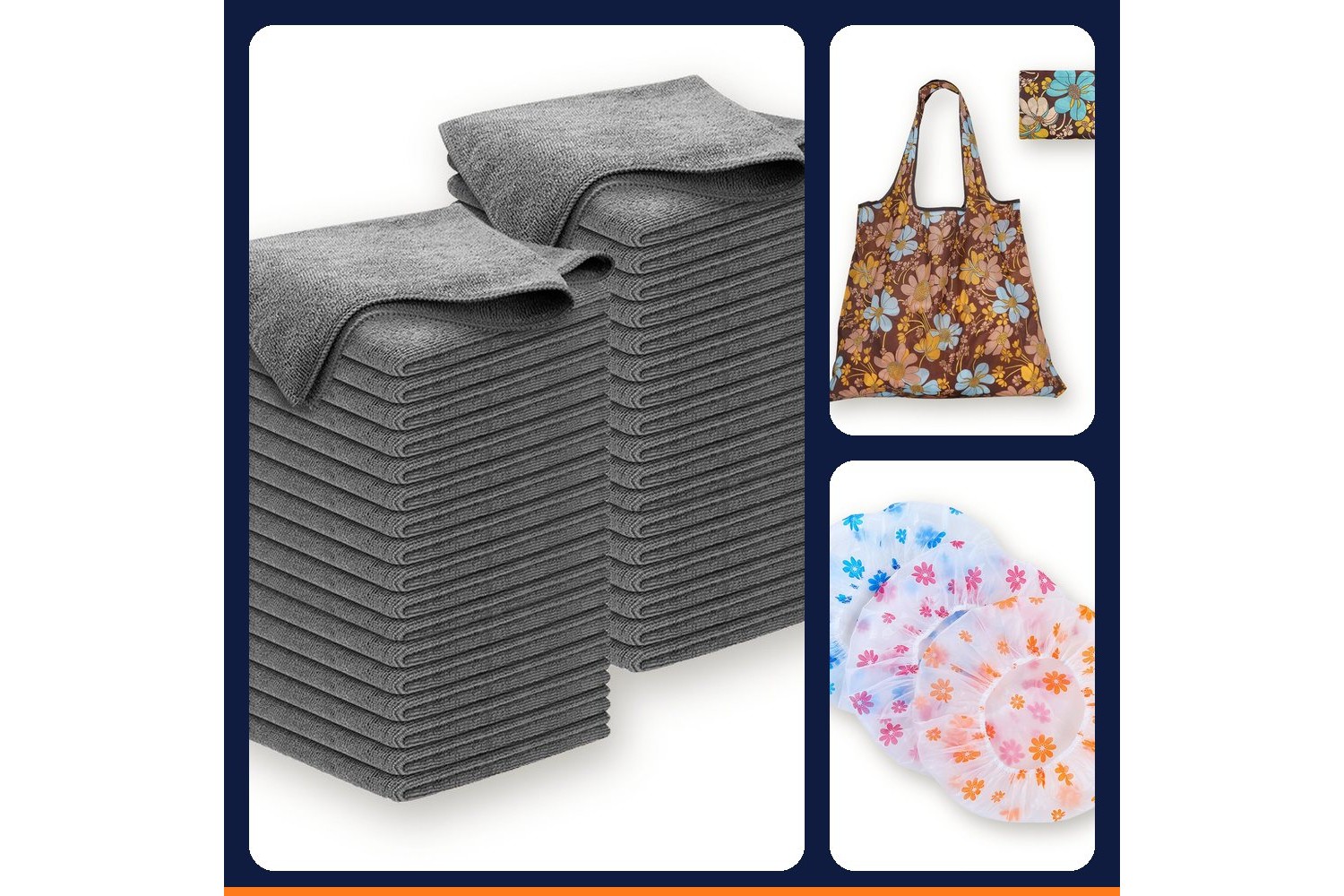
A minimarket's own brand starts not with a logo but with a list of goods customers pick up without looking at the brand: cleaning cloths, gloves, shopping bags, cables. These are the lines where a chain can put its name and have a product the shop next door does not stock. This article covers non-food only: food, alcohol and tobacco fall under separate national rules, and an own brand in those categories is a different task.
In brief
- Simple consumables with steady demand, where shoppers are not looking for a famous name, suit an own brand.
- There are three levels: a logo on a finished product, your own packaging, and production to your requirements (OEM/ODM).
- For household goods the brand lives mainly on the packaging: label, insert, box.
- Branding lengthens the lead time: artwork and production are added.
- The name is checked against trade mark databases before the first batch is ordered.
Why a minimarket needs its own brand
A neighbourhood shop competes with similar shops and with large chains. The price of a well-known product is easy to compare; a product under the shop's own brand has nothing to be compared with. That is the first reason.
The second is recognition. Customers come in often, and the same brand on cloths, gloves and a bag gradually becomes familiar. A bag carrying the shop's name also works as advertising on the street.
The third is shelf control. For your own brand you choose the pack size, the number of units and the design so that the product fits your hooks and display boxes. For a chain with several sites it also means a consistent non-food shelf in every shop.
Which products suit an own brand
Choose lines that already sell steadily unbranded. An own brand does not create demand; it secures the demand that exists.
Shopping bags. The most visible carrier: a large print area, and the customer uses the bag for months. Models are in the category “Shopping bags”.

A mesh bag for shopping and the beach is a light checkout item; the chain's name fits on the tag or handle.
Cloths and sponges. A consumable with repeat purchase. The product itself is usually not branded – the brand lives on the label and in the set: several cloths in a pack with your design. See the category “Cloths and sponges”.

A microfibre cloth for kitchen and car care: a set under your own label turns it into a store-brand product.
Gloves. A box of disposable gloves is a ready-made design surface, and shoppers choose by size and material, not by the maker's name. Category: “Aprons and household gloves”.

Powder-free nitrile gloves in a box of 100 – a self-explanatory product where the packaging carries the brand.
Cables and small charging accessories. They sell at the till in individual packaging that can be designed in your style. The choice is in the category “Cables and adapters”. For electronics, documents are the first thing to ask for.
Three levels: logo, packaging, OEM/ODM
Logo on a finished product. You choose a line from the catalogue and the manufacturer applies the mark: printing, engraving or embossing, depending on the material. For bags this is the fastest route. The terms are on the Private Label page; branding is available for more than 8,000 items.
Your own packaging. A label, a card hanger, a box or a bag with your design and labelling for your market. For household goods this is the main level: the product stays standard but looks like the shop's own line on the shelf.
OEM/ODM. Production to your requirements: size, weight, colour, contents of the set. It makes sense once the line is selling and it is clear what should change in the finished goods. More on the OEM/ODM production page.
Name and trade mark
There are two routes. In the first, the brand matches the shop's name: customers see at once whose product it is, and all promotion builds one name. In the second, the line has a separate name: this is used when the goods are varied and one name does not suit them all, or when the chain plans to sell the line outside its own shops as well.
The name should be legible on a small label and in one colour. A trade mark is registered with a national office or with the EUIPO, which covers the whole EU. Household goods, bags and electronics belong to different classes, so the list of classes is decided in advance. Search the public databases before ordering packaging; for the procedure and cost of registration, contact the office or a trade mark attorney.
Packaging and labelling
Packaging for a minimarket solves practical tasks: a hang hole for the hook, a size that fits the display box, a name and purpose that can be read from a step away. Create one template – colour, typeface, position of the mark – and apply it to every line: three different products then look like one range.
Labelling is the mandatory part. Under the EU General Product Safety Regulation, the product or packaging carries the details of the manufacturer and of the responsible person in the EU. When goods are sold under your name, the labelling requirements concern you directly – discuss the wording with the account manager and your own legal adviser. Electronics need CE marking and food contact items need the relevant documents; ask the manager for them before payment. Consumer texts are written in the language of the country of sale, and the till needs a barcode.
From sample to batch
- Sample. Choose the product and ask for a sample or a small trial batch – by arrangement with the account manager. Test it in use: wash it, stretch it, charge a phone.
- Artwork. Supply the logo in vector format, the texts and the packaging dimensions. The manufacturer prepares a proof of the print or packaging.
- Approval. Check colours, texts, barcode and labelling. Corrections after production has started are expensive.
- Production. Once the pro forma invoice is paid, the batch goes into production. The lead time is longer than for unbranded goods.
- Quality control. The batch is inspected before dispatch; how this works is described on the quality control page.
- Delivery. The cost is calculated per batch; after shipment you receive a tracking number and the documents. The terms are on the delivery page.
What the budget consists of and common mistakes
The budget is made up of the batch of goods, the printing of the logo or packaging, the artwork and template, barcodes, trade mark registration and delivery. The minimum order value is 500 EUR net per item; an order under your own brand starts at 5000 EUR, and the manager states the details in the quotation.
- Starting with a product that did not sell even unbranded.
- Launching ten lines at once instead of two or three.
- Making packaging attractive but awkward for the shelf: no hanger, wrong size for the display box.
- Not checking the name against trade mark databases.
- Ignoring the lead time: branded goods have to be ordered earlier than standard ones.
Frequently asked questions
Does an own brand suit a single shop rather than a chain?
Yes, if it starts simply: a bag with a logo or a set of cloths under your own label. Discuss the batch size with the account manager.
Which product to start with?
A shopping bag: the logo goes onto a finished model and the result is visible at once – in the shop and on the street.
How much longer does a branded order take?
Artwork, approval and production are added to the usual 20–60 days. The exact lead time depends on the product; the manager will confirm it.
Can the brand cover both standard goods and goods made to your requirements?
Yes. Most start with finished lines in their own packaging and move to OEM/ODM for one or two best-selling products.
Pick two or three fast-moving lines in the “Minimarket chains” section and write to the manager via the contact page to discuss printing and packaging. If the non-food shelf is not yet in place, start with the article “How to open a minimarket: non-food range”.
