
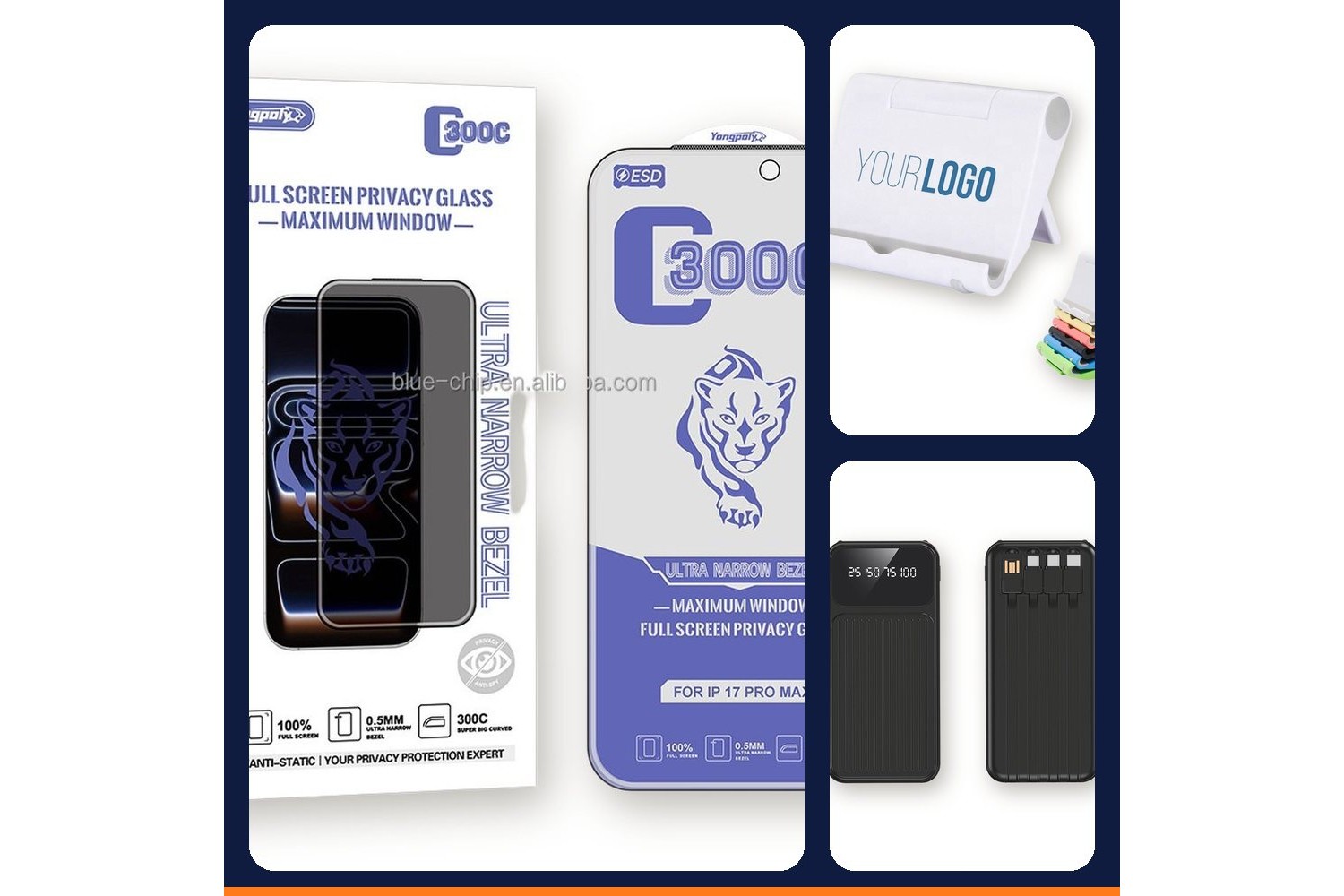
Your own phone accessory brand starts with one or two product groups that already sell steadily for you, and with a simple step: a logo on a finished product and your own packaging. Developing a unique product is not needed straight away; first the brand has to become recognisable on the shelf or in marketplace search. Below is which products to choose, how to handle the name and packaging, and how to get from sample to batch.
In brief
- Universal products suit a brand best: chargers, cables, power banks, stands, straps. They do not become obsolete when new smartphones are released.
- There are three levels: a logo on a finished product, your own packaging, and production to your requirements (OEM/ODM).
- The name is checked for availability and registered as a trade mark, at a national office or at the EUIPO for the whole EU.
- Electronics packaging needs the details of the manufacturer and the responsible person in the EU, the CE marking and safety information.
- Branding extends the lead time, so a seasonal batch is planned with a margin.
Why a brand matters in this niche
Buyers compare unnamed accessories on price alone: two cables that look identical in marketplace search differ only by a number. A brand gives the listing and the packaging something to hold on to: a name, a consistent style, a promise of quality. A buyer who liked the charger comes back for a cable of the same name; without a name there is nothing to come back to.
In a physical outlet the brand works as merchandising: a shelf of products in matching boxes looks like a line rather than a set of random items, and staff find it easier to explain the difference between models. For business customers an own brand is an argument in negotiations: you offer not a "power bank from a catalogue" but a product with packaging and instructions. Finally, a brand avoids direct comparison: the same product under your name cannot be found cheaper next door.
Which products in the niche suit an own brand
The best candidates are products that are not tied to a phone model and sell all year round. A branded batch will not lose its value after a season.
Power: chargers, power banks, wireless stations. The housing has a flat area for a logo, and the box displays the specifications.

A power bank with built-in cables: a flat panel for the logo and a clear difference from ordinary models.
Cables and adapters and memory cards are products where the name and packaging create almost all of the perceived difference.

An unbranded memory card: a logo and your own packaging turn a nameless product into part of your line.
Stands, holders, straps and lanyards are inexpensive items with a generous print area. They are a convenient starting point: the buying decision is simple and the logo is clearly visible.

A plastic desktop stand: a flat surface for printing a logo and demand throughout the year.

A silicone finger strap: a small accessory for a first test of the brand and for customer gifts.
Branded cases are possible but call for caution: the batch is tied to a smartphone model and has to sell before the generation changes. Start with mass-market models and small quantities.
Three levels: logo, packaging, OEM/ODM
The first level is a logo on a finished product. The method depends on the material: printing on plastic and silicone, engraving on metal, embossing on leather and its substitutes. This is the fastest route, and on the platform it is available for more than 8,000 items; details are on the page about private label.
The second level is your own packaging: a box, blister or pouch with your design, an instruction insert, labelling for the market. For accessories this often matters more than a logo on the housing, because in a shop the buyer sees the box first.
The third level is OEM/ODM production: your own housing colour, kit contents, cable length, connector combination, shape. It follows once the brand is already selling and it is clear what the ready-made models lack. The deeper the changes, the larger the batch and the longer the preparation.
The name and the trade mark
The name should be easy to pronounce in the languages of your markets, should not describe the product directly and should not resemble the brands of smartphone and electronics makers. Before ordering packaging, check whether the name is taken: public trade mark databases, marketplaces, domains. A mark can be registered at a national office for one country, or at the EUIPO, in which case protection covers the whole EU. Choosing classes and filing the application is best left to a trade mark attorney. On some marketplaces a registered mark gives access to brand protection tools; check the terms with the platform itself.
Packaging and labelling
Accessory packaging does three jobs: it protects in transit, sells on the shelf and carries mandatory information. Under the General Product Safety Regulation (GPSR), the product or packaging shows the details of the manufacturer and the responsible person in the EU. Electronics also need the CE marking and RoHS compliance, and products with batteries need the markings required by EU battery rules. Request the documents behind this labelling from the manager before payment: under your brand, questions from authorities and platforms will be addressed to you.
Keep the essentials on the front of the box: name, product type and the key specification, such as wattage, capacity, length or connectors. Texts are needed in the language of the country of sale. Phone models may be mentioned only as a compatibility statement, without other companies' logos.
From sample to batch
- Sample. Choose the items and ask the manager about a sample or a small trial batch; this is arranged by agreement. Test the product in use: heat, charging speed, connector durability.
- Artwork. Prepare the logo in vector format and the packaging design on the manufacturer's template.
- Approval. Confirm the position and size of the logo, the colours and the labelling texts. All corrections are made at this stage, not later.
- Production. Once the pro forma invoice is paid, the batch is manufactured; the artwork and production stage is added to the usual lead time.
- Inspection. Before dispatch the goods undergo quality control: say in advance what to check, such as the print, the kit contents and the packaging.
- Delivery. After dispatch you receive a tracking number and documents; the guide figure for delivery times is 20–60 days.
What the budget consists of and common mistakes
A brand budget is made up of the batch of goods, logo application, packaging design and printing, samples, delivery, trade mark registration, and photos and descriptions for listings. Set aside a separate reserve for a repeat batch: a brand that is out of stock loses the ground it has gained.
What to avoid:
- launching a wide line at once instead of two or three proven products;
- ordering a packaging print run before checking that the name is free;
- putting the brand on a product you have not tested in use;
- using other brands' logos and names on the box;
- paying for electronics without having received the documents;
- planning a delivery for the festive season with no margin for the artwork stage.
Frequently asked questions
What is the minimum quantity for products with a logo?
The minimum batch for branding depends on the product and the method; the manager states it in the quotation. The general condition is a minimum order value of EUR 500 net.
Does the trade mark have to be registered before the first batch?
The law does not require it, but the name must be checked for availability before the packaging is printed. Many file the application alongside the first batch so as not to invest in a name that will have to be changed.
How much longer does delivery take with branding?
The artwork, approval and production stage is added to the estimated 20–60 days. A logo on a finished product is quicker than own packaging or changes to the product. The manager gives the exact lead time.
Can cases be released under an own brand?
Yes, but this is the riskiest group: the batch is tied to a specific smartphone model. Take mass-market models, small quantities and a neutral design, and build the core of the line on universal products.
Choose two or three products that already sell, check the name and request a quotation. Items for a first line are collected in the section of products for phone accessory shops, the wholesale registration unlocks prices, and branding questions can be asked via the contact page. If the shop is still at the planning stage, start with the article on opening a phone accessory shop.
