
A garden products brand is best started with simple items that have no motor or electronics – watering accessories, barbecue sets, hand tools: they need fewer documents, are cheap to ship, and packaging with your name sets the product apart on the shelf at once. The first step is a logo on a ready-made product and your own box; branded machinery and furniture come later, once the name starts to be recognised. Live plants, seeds, fertilisers and plant protection products are not covered here: they are regulated separately.
In brief
- Watering equipment, barbecue accessories and hand tools suit a start: simple construction and few documents.
- Three levels: a logo on a ready-made product, your own packaging and instructions, production to your requirements (OEM/ODM).
- The name is checked for availability and registered as a trade mark – at a national office or at the EUIPO for the whole EU.
- When a product goes out under your name, questions about it come to you: request documents for machinery before payment.
- Branding lengthens delivery and the season is short – a spring batch is planned from the autumn.
Why a brand matters in this trade
Garden products are bought in a hurry, at the start of the season, and on Amazon or eBay the same sprayer or barbecue set appears in dozens of listings with one factory photograph. Without a name, a seller competes on price alone. A brand creates the difference – its own packaging, instructions in the customer’s language, clear contents, photography in a garden – together with a name by which the product can be found next season.
The trade has a useful feature: a garden is set up over years. Someone who was happy with your drip watering buys parts for it a year later, then looks for tools and furniture. If the products share a colour and are compatible with one another, the next purchase comes to you. In a physical shop, a line under your own name sets you apart from the DIY superstore nearby. Hotels and cafés with terraces can be offered furniture and accessories under your brand or with their logo.
Which products suit an own brand
There are three criteria: the product is simply built and needs no servicing, there is room for the brand on it or on the packaging, and demand returns every season.
Watering equipment is the simplest way in. Drippers, connectors and spray guns are sold as kits, and here the brand lives on the packaging: a blister or box with your name, an assembly diagram and a list of compatible parts.

Drip cone for a plastic bottle: a small item from which branded watering kits can be put together.
Barbecues and their accessories are gift products. A tool set in a case takes engraving on metal and decoration on the case; it is bought at the start of the season and for holidays.

38-piece barbecue set in an aluminium case: a gift line with room for a logo on the case.
Garden furniture suits a brand that works with terraces, cafés and hotels. Here the brand means your own palette for frame and cushions, a tag on the product, assembly instructions and packaging that survives transport.

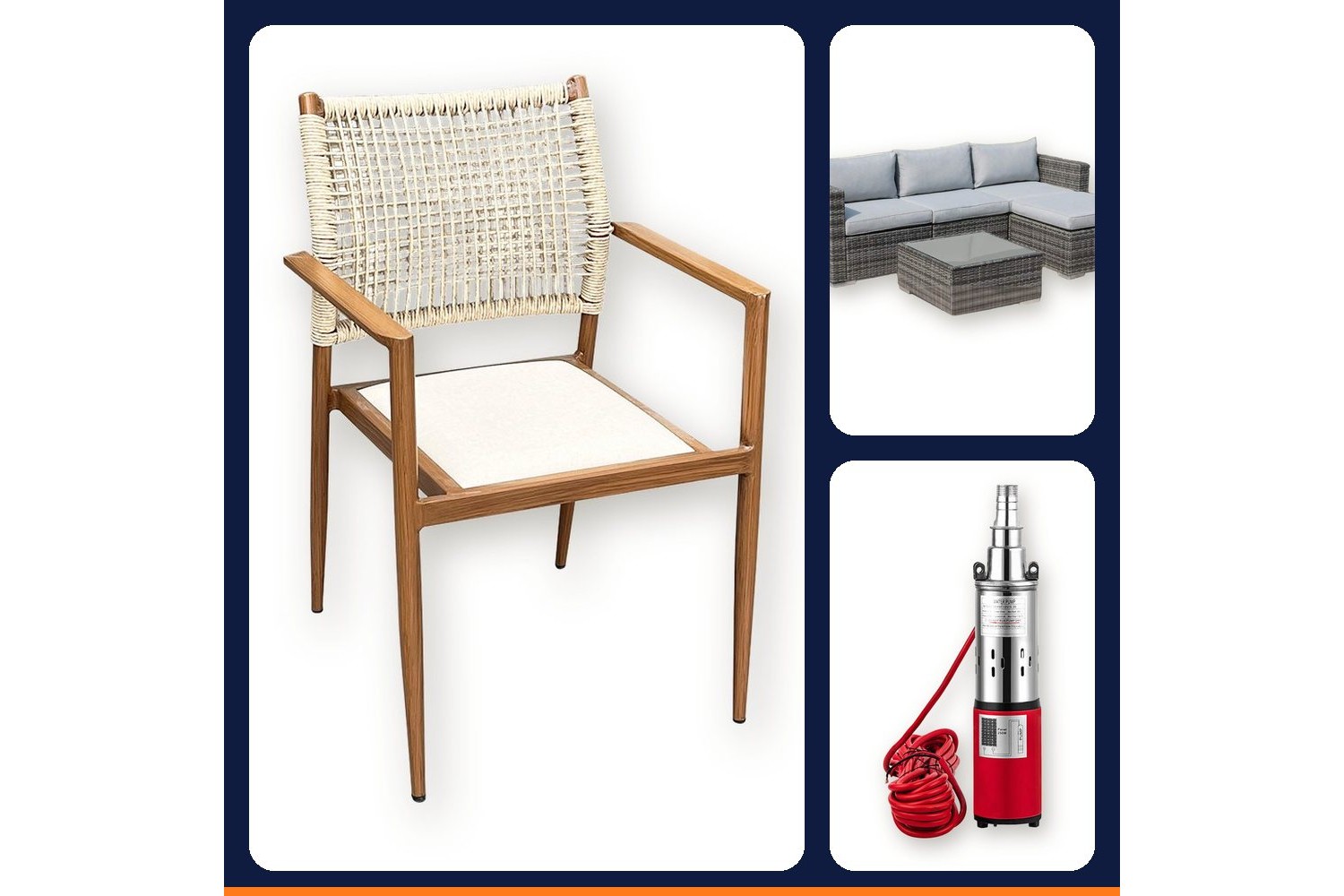
Dining chair with a woven back and tables on aluminium frames: the basis of a line for terraces and cafés.
Cordless machinery – pruners, cultivators, lawnmowers – is the next step. It gives the brand weight but requires documents, instructions, spare batteries and an answer to the question of servicing.

Cordless 20 V pruner with a brushless motor: the first machine in the line once the brand is already selling.
Own-brand greenhouses, pumps and generators are possible, but they are bulky goods with many parts and come last.
Three levels: logo, packaging, OEM/ODM
The first level is a logo on a ready-made product. The method depends on the material: engraving on metal, print on plastic and fabric, embossing on cases and covers. This is the fastest route and is available on the platform for more than 8,000 items; the terms are set out on the page about private label.
The second level is your own packaging: a box or blister in your design, instructions in the languages of your markets, an assembly diagram, a label with the required marking. For garden products this is often what matters most: in a shop the customer sees the box, not the product, and uses it to decide whether the item fits their hose, terrace or barbecue.
The third level is OEM/ODM production: your own housing colour, contents, handle material, cushion fabric, battery capacity. It follows once reviews show what ready-made products lack. The deeper the changes, the larger the batch and the longer the preparation.
Name and trade mark
The name should be easy to pronounce in the languages of your markets and legible on a small label. Before ordering packaging, check that it is free: public trade mark databases, marketplaces, domains, social media. A mark can be registered at a national office – for one country – or at the EUIPO, in which case protection covers the whole EU. Choosing classes and filing the application is best left to a trade mark attorney. On some marketplaces a registered mark gives access to brand protection tools; check the terms with the marketplace itself.
One rule specific to the trade: do not repeat the signature colours and shapes of well-known garden machinery makers, and do not claim compatibility with other makers’ systems on the packaging unless it is confirmed.
Packaging and labelling
Under the General Product Safety Regulation (GPSR), the product or packaging shows the details of the manufacturer and of the responsible person in the EU. When a product goes out under your name, questions from customers and market surveillance authorities come to you, so the documents need to be in your hands before sales begin.
Motor-driven machinery, electrical equipment and batteries need CE marking, a declaration of conformity and instructions in the language of the country of sale; RoHS requirements apply to electronics. For barbecue grates and tools, request documents for food contact materials. Ask the manager for all of this before payment. Packaging has to withstand the journey: furniture and machinery travel in cartons with corner protection, so the box design is agreed together with its dimensions and construction.
From sample to batch
- Sample. Choose the products and ask the manager for a sample or a small trial batch – this is arranged by agreement. Test the sample in use: assemble it, connect it, leave it outdoors in rain and sun.
- Artwork. Prepare the logo in vector format and the packaging and instruction design on the manufacturer’s template.
- Approval. Confirm the position and method of decoration, colour, contents, and the labelling and instruction texts. No corrections are made after this stage.
- Production. Once the pro forma invoice is paid, the batch is made; the artwork and production stage is added to the usual lead time.
- Inspection. Before dispatch the goods go through quality control: say in advance what to check – decoration, completeness, motor operation, packaging.
- Delivery. After dispatch you receive a tracking number and documents; the guide figure for delivery time is 20–60 days.
What the budget consists of, and common mistakes
A brand budget consists of the stock itself, decoration, packaging and instructions, samples, delivery, trade mark registration, garden photography and listing copy. For machinery, add spare parts and batteries. Set aside a separate reserve for the repeat batch: at the height of the season a branded reorder will not arrive in time.
What to avoid:
- starting with machinery instead of simple products with no motor;
- printing packaging before checking the name;
- putting your name on a product you have not tested yourself;
- releasing a product without instructions in the customer’s language;
- ordering a branded spring batch in February: the artwork stage leaves no margin;
- promising more on the packaging than the documents confirm.
Frequently asked questions
What is the minimum quantity for garden products with a logo?
The minimum batch for decoration depends on the product and the branding method; the manager states it in the quotation. The general condition is the minimum order value of 500 EUR net. Questions about a specific product can be sent through the contact page.
Can seeds or fertilisers be released under an own brand?
These are regulated products with separate requirements for registration, labelling and sale; the rules depend on the country. It makes sense to build the brand on tools, watering equipment, furniture and accessories, and to discuss regulated groups with a specialist lawyer.
Must the trade mark be registered before the first batch?
The law does not require it, but you need to be sure the name is free before printing packaging. Many file the application in parallel with the first batch, so as not to invest in a name that will have to change.
How much does branding lengthen delivery?
The artwork, approval and production stage is added to the estimated 20–60 days. A logo on a ready-made product is quicker than your own packaging or changes to the contents. The manager gives the exact lead time.
Pick two or three products that already sell for you and look at the options in the section of goods for garden centres. If the shop is still at the planning stage, start with the article on how to open a garden centre.
