
A DTC brand is not a logo or a handsome website but a promise the customer recognises at every point of contact: in the advert, on the storefront, in the box and in the product itself. In your own sales channel there is no platform between you and the customer, so the brand works harder than anywhere else, and mistakes show more. Most start small: a logo on a ready-made item and on the packaging. Below: how to word your positioning, choose a product for your own label and go from sample to batch.
In brief
- Positioning first – who the brand is for and how it differs – then logo and packaging.
- Three levels: a logo on a ready-made product, your own packaging and labelling, production to your requirements (OEM/ODM).
- In DTC, packaging replaces the shop shelf: the customer judges the brand by it before seeing the product.
- The name is checked before a batch is ordered; the mark is registered with a national office or with the EUIPO for the whole EU.
- Branding lengthens the lead time: artwork, approval and production are added.
Why a brand matters in your own channel
The first reason: winning a customer costs money and pays back through repeat orders. Nobody comes back for a nameless product – next time it is bought wherever it is cheaper. People return to a brand they remember directly: via the site, the newsletter, social media.
The second reason is escaping price comparison. An identical unnamed product is easy to find with other sellers, for instance on Amazon or eBay. An item with its own mark, its own packaging and its own story has nothing to be compared with directly.
The third reason is trust. A person visits your store for the first time and pays in advance. Neat packaging, a hang tag and an insert with clear return terms show that a real company stands behind the site.
The fourth reason is content. A product with character and an unboxing worth filming provide material for social media and reviews; without that, your own channel struggles to grow.
Positioning: where a brand begins
Before any artwork, answer four questions in writing: who your customer is, what need they are meeting, how your product differs from the rest and what tone you speak in. Practical decisions follow from the answers: palette, packaging materials, price level, the wording on the tag. A brand for hikers and a brand of gifts for newborns will choose different boxes even if both sell textiles. Good positioning is narrow: it says plainly who the brand is not for. Put the answers on one page and check every decision against it – from the colour of the box to the wording of an advert.
Which products suit your own label
Choose items on which the mark is clearly visible and the decoration is technically simple.
Clothing. Plain T-shirts and hoodies with no third-party decoration are the usual base: a print or embroidery on the front, your own neck label, a hang tag. One model in several colours already looks like a line.
A brand character. A mascot makes the brand recognisable and becomes a product in its own right; items made from your own drawing are in the “Mascots” category.
Tags and swing labels. The most affordable carrier of the mark: a tag turns a basic item into a branded product and carries mandatory information.

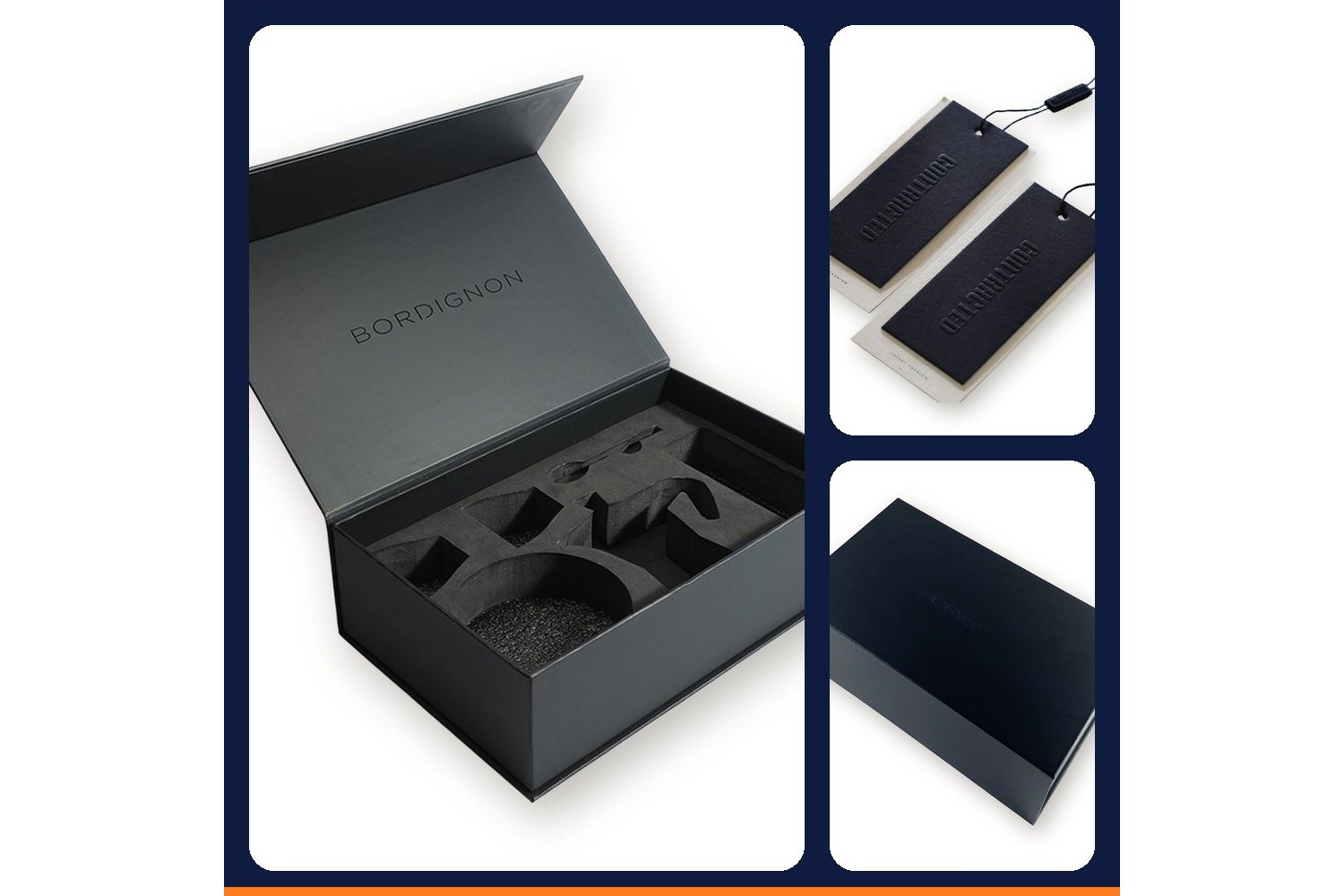
A cardboard hang tag with an embossed logo is the first and cheapest step towards your own label.
Formats and materials are in the “Tags” category.
Branded packaging. A rigid box for gift and higher-priced items, a bag for collection orders and events.

A laminated rigid magnetic box with custom print and size: packaging the customer keeps.

A paper bag with full-colour print from your artwork – for collection, fairs and gift orders.
Construction options are gathered in the laminated rigid boxes category.
Three levels: from a logo to your own product
Level 1. A logo on a ready-made product. You choose an item from the catalogue and add the mark: printing, embroidery, engraving or embossing, depending on the material. Branding is available for more than 8,000 items. The risk is minimal: the product already exists and only the finish changes.
Level 2. Your own packaging and labelling. The logo is joined by a branded box or bag, a tag, an insert and labelling for the market of sale. In DTC this level often matters more than the first: unboxing is the only “shop window” the customer holds in their hands. Details are on the Private Label page.
Level 3. OEM/ODM. Production to your requirements: your own materials, sizes, colours, construction. You move to it once demand is confirmed and it is clear exactly what to change in the product. The terms are on the OEM/ODM page.
Move up a level only after sales at the previous one: that way each investment rests on confirmed demand.
Name and trade mark
The name should be easy to pronounce in the languages of your markets, should not describe the product literally and must be free: check the domain, social media handles and trade mark databases. A mark is registered with the national office or with the EUIPO, in which case it is valid across the EU. The application is filed by classes of goods; choosing the classes and searching for similar marks is best left to a trade mark attorney. Do the check before ordering a batch with the logo: reprinting packaging because of a name conflict is expensive.
Packaging and labelling
In DTC, packaging has three jobs: to deliver the product intact, to make an impression and to convey mandatory information. The shipping box must withstand transit; the inner packaging can be light if there is protection outside. Under the EU General Product Safety Regulation, the item or its packaging carries the details of the manufacturer and the responsible person in the EU. Clothing needs the fibre composition in the language of the country of sale; toys, electronics and other categories covered need CE marking. An insert with a thank-you, care advice and the returns procedure costs little and saves many support enquiries. Make environmental claims (“recycled”, “biodegradable”) only when you hold supporting documents. Request certificates and declarations from the manager before payment.
From sample to batch
- Sample. Choose the base item and packaging; a sample or a small trial batch is arranged by agreement with the manager.
- Artwork. Prepare the logo in vector format and state the position, size and method.
- Approval. Confirm the artwork and batch contents in writing: colours, sizes, quantities, labelling text.
- Production. After the pro forma invoice is paid, the batch is decorated or produced; this stage lengthens the lead time.
- Inspection. Before dispatch the batch goes through quality control.
- Delivery. You receive a tracking number and documents; the indicative lead time is 20–60 days, not counting artwork.
What the budget consists of, and typical mistakes
A brand budget consists of developing the name and logo, checking and registering the mark, samples, a batch of goods with decoration, packaging and labelling, delivery, photography and the advertising launch. The minimum order value is 500 EUR net per item; an order under your own brand starts at 5000 EUR; the unit price depends on volume and decoration method.
- Starting with a logo without deciding who the brand is for.
- Ordering OEM straight away without testing demand on a ready-made item.
- Designing a complex mark with fine details that embroidery and embossing cannot reproduce.
- Not checking the name before the batch is printed.
- Forgetting mandatory labelling when designing the packaging.
- Leaving no time for artwork and production before the season.
Frequently asked questions
Can you start a brand with a small batch?
Yes. Minimum batches and decoration costs depend on the item and method; the manager states the terms for a specific item in the commercial offer.
What should be branded first – the product or the packaging?
On a limited budget, start with the hang tag and shipping box: they fit every item at once. Add decoration on the product itself for your hero products.
Must the trade mark be registered before launch?
The law does not require it, but the name should be checked before ordering, and it is better to file before heavy advertising – otherwise you are investing in an unprotected name.
How much does branding lengthen delivery?
Artwork, approval and production stages are added. The exact time depends on the item and volume and is given by the manager; plan seasonal launches with a margin.
Put together a first line of one or two items, a tag and a box in the “Shopify / DTC brands” section and request a quote with decoration. If the store is not yet running, start with the article “How to launch your own online store and DTC project”.
