
Your own camping gear brand does not require your own factory: it is enough to choose proven products, add your logo and pack them under your name. It makes sense to begin with two or three products that already sell for you and move to made-to-specification items later. Below: which products suit a brand, how the levels of branding work and what to allow for in the timeline.
In brief
- Build the first line from products with clear demand and a convenient surface for a logo: textiles, covers, bags, cookware.
- There are three levels: a logo on a finished product, branded packaging, and production to your specification (OEM/ODM).
- Check that the name is free and apply for a trade mark before ordering a packaging print run.
- Branding extends the lead time by the artwork and production stage – plan a summer line from autumn.
- Packaging must carry the details of the manufacturer and the responsible person in the EU, plus information in the language of the country of sale.
Why a brand matters in camping
Customers judge camping gear in the field: the chair either lasted the season or it did not. If it did, they want the same one for the people on the next pitch, or the table from the same series – and they search by the name on the label. Unbranded goods give them no way to do that: the repeat purchase goes to any seller with a similar picture.
The second reason is marketplaces. Identical listings on Amazon or eBay are compared on price alone, while a branded product with its own photographs and packaging steps out of direct comparison. The third is trade customers: campsites, hire firms and trip organisers prefer a seller with a recognisable line who can repeat the order in the same form a year later.
Finally, gear gets photographed a lot. A logo on a chair back or a cool bag ends up in other people’s holiday pictures and works for longer than an advert.
Which products suit your own brand
The easiest start is with items that have a flat, visible surface and need no complex modification. In the umbrellas and rainwear category that surface is the canopy: a print on it can be seen from a distance.

An automatic umbrella with UV protection is designed to take a logo from the outset – an easy first line.
Picnic textiles – bags, cool bags, blankets – take printing and embroidered patches well. Products in the picnic category are bought by families and as gifts, so careful packaging has a noticeable effect on the choice.

A foldable Oxford cool bag: a large print area and a benefit every buyer understands.
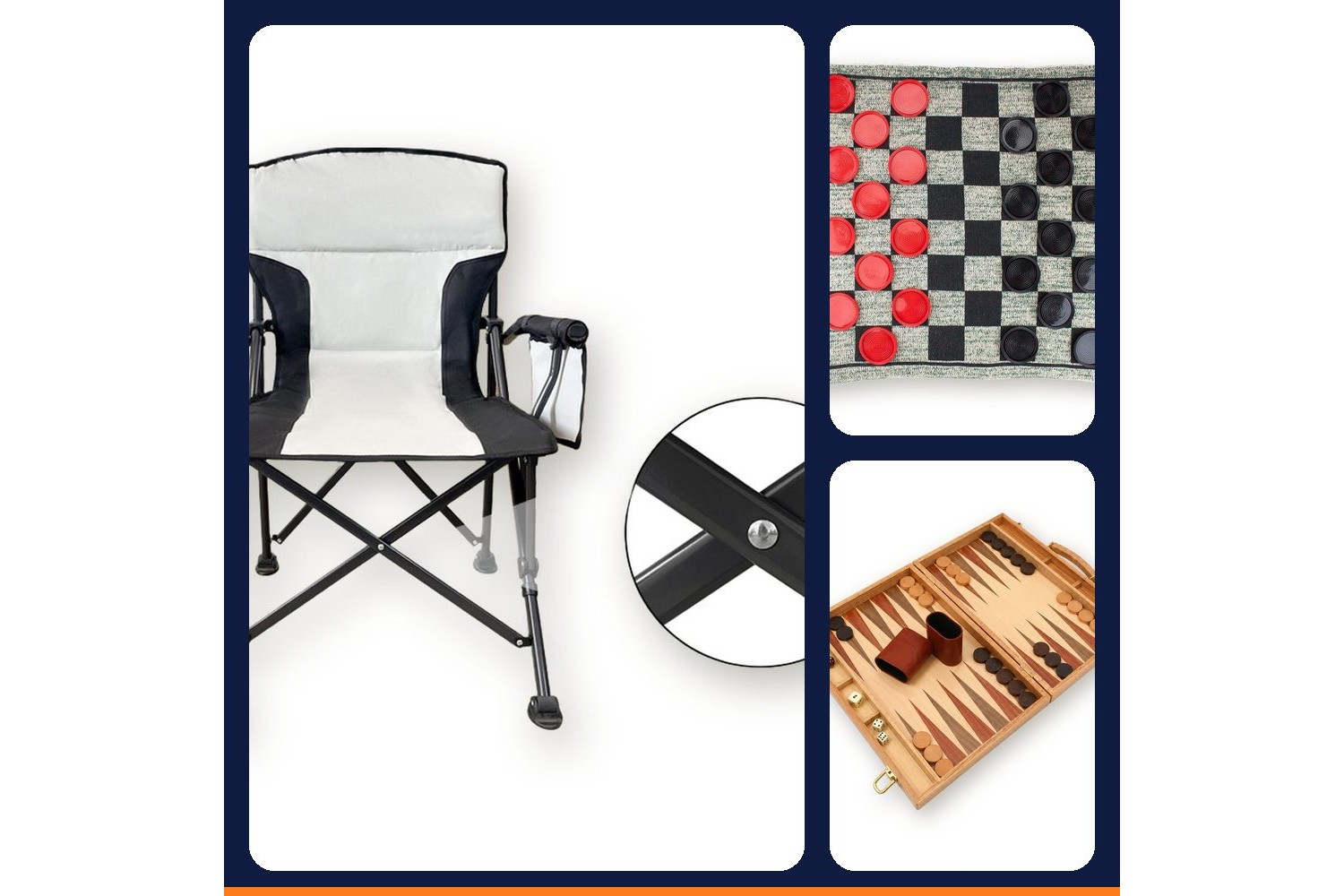
The next group is folding camping chairs and tables. The logo goes on the backrest and on the carry bag. Furniture sets the character of the whole line: customers judge the durability of the brand’s other products by it, so the sample deserves especially close testing.

A chair with armrests and a carry bag: the logo on the backrest shows in every photo from the campsite.
Small items for the camp kitchen round out the line and look like a gift set in a branded box.

A collapsible kettle with mugs in an own-brand box becomes a ready-made gift set.
At the first stage it is better not to brand everything. Three or four products for one use – ‘picnic by the car’, for instance – look like a line. Ten unrelated products with the same logo look like a random assortment.
Three levels: from a logo to your own product
The first level is a logo on a finished product. The method depends on the material: printing on fabric and plastic, engraving on metal, embossing on leather and leather substitutes. The construction stays the same, so this is the quickest way in. Branding is available for more than 8,000 products in the catalogue; the terms are set out on the Private Label page.
The second level is your own packaging: box, insert, label, swing tag, marking for the market of sale. The product remains a standard one, but on the shelf and in the listing it looks like yours. In camping, packaging also does practical work: it states the load rating, folded dimensions, weight and care instructions.
The third level is production on an OEM/ODM basis: the item is made to your requirements – your colours, fabric, contents and dimensions. This route is justified once the first consignments have confirmed demand and you know exactly what you want to change in the standard model.
Name and trade mark
The name should be easy to read in every language you sell in and should not describe the product directly: words such as ‘camp’ or ‘outdoor’ are hard to protect on their own and get lost among similar names. Check that the domain and social media handle are free and that no similar mark is registered in your class of goods.
A trade mark is registered with the national office if you sell in one country, or with the EUIPO, in which case protection covers the whole EU. It is sensible to file before ordering a packaging print run: changing a name on finished boxes is expensive. Registration also helps on marketplaces that give brand owners additional tools. Discuss the details of the procedure with a trade mark attorney.
Packaging and labelling
Packaging for outdoor products has to survive transport, storage and delivery to the customer. For large items the main packaging is the shipping carton, made recognisable by print and a sticker. For small items and sets the box does the selling: it needs a photograph of the product in use and a short list of specifications.
Under the EU General Product Safety Regulation (GPSR), the product or its packaging carries the details of the manufacturer and of the responsible person in the EU. Customer information and warnings are given in the language of the country of sale. If the item belongs to a category with separate requirements – electrical products, food-contact cookware, children’s products – the labelling must meet them, for example with CE marking where it is mandatory. Ask your account manager for the documents on such products before payment.
From sample to shipment
- Sample. Complete wholesale registration and order samples of the chosen products: a sample costs 150 EUR and is refunded when you place the order. Test them in real conditions – set them up, load them, get them wet.
- Artwork. Prepare the logo as a vector file and describe where and how it should be applied. The account manager confirms the available options and the size of the branding area with the manufacturer.
- Approval. You receive a quotation with price, lead time and delivery cost, approve the artwork and pay the pro forma invoice by bank transfer.
- Production. Manufacturing and branding take additional time on top of the usual lead time.
- Inspection. Before dispatch the consignment goes through quality control: match to the artwork, completeness, packaging.
- Delivery. After dispatch you receive a tracking number and documents; factor the terms of delivery within the EU and the 20–60 day estimate into your launch plan.
What the budget consists of, and common mistakes
The budget of an own brand is made up of the goods, logo application, packaging print, delivery, trade mark registration, photography and samples. The share of each item depends on the product and the run size, so the calculation is based on the quotation for a specific consignment, not on averages.
New brands tend to make the same mistakes:
- ordering a branded run without testing the sample in use;
- starting with an OEM product without knowing what customers actually need;
- printing packaging before checking that the name is free;
- tying the launch to the shortest lead time and receiving the summer line in mid-season;
- branding unrelated products that do not form a series;
- not planning the reorder: the next branded consignment needs production time again.
Frequently asked questions
What is the minimum quantity for products with a logo?
An order under your own brand starts at EUR 5000; the account manager confirms the details with the manufacturer and states them in the quotation. The platform’s general minimum order value is EUR 500 net per item.
How much does branding add to the lead time?
The artwork and production stage is added to the estimated 20–60 days for delivery. Its length depends on the item, which is why a summer line is prepared from autumn.
Is it possible to start with packaging only, without changing the product?
Yes. A branded box, insert or swing tag on a standard item is a private label level in its own right. It is often chosen for sets and gift products.
Who is responsible for the product meeting EU requirements?
Whoever places the product on the market under their own name generally takes on the obligations for its safety and labelling. That is why documents are requested before payment and the labelling content is agreed at the packaging artwork stage.
Choose one use, two or three products for it, and test them with a small order. Suitable products are in the range for camping shops. If the shop is still at the planning stage, begin with the article on opening a camping shop.
