
A repair shop has something an ordinary accessory seller lacks: the customer’s trust at the moment the device has just been fixed. Branded accessories under the shop’s name – cables, screen protectors, cases, hand-back packaging – turn that trust into sales and remind people of the workshop after the visit. It does not start at a factory. It starts with a logo on finished goods and a neat bag in which the customer carries the phone away. Below: what to put under your own brand, how the three levels of branding differ and how to get from sample to batch.
In brief
- The first step is a logo on finished accessories and hand-back packaging; the second is your own retail packaging; the third is a product made to your requirements.
- Cables and adapters, screen protectors, cases, small consumables and tool sets all suit a repair shop’s brand.
- Hand-back packaging is the simplest carrier of the brand: every customer receives it.
- Check the name in trade mark databases; device manufacturers’ logos have no place in your own design.
- Branding lengthens the lead time: artwork and production are added to the 20–60 days of delivery.
Why a repair shop needs a brand
The first reason is the moment of purchase. The customer collects a phone with a new screen and asks how to protect it. A protector and case bearing the workshop’s name look like the technician’s recommendation, not a random item from the display.
The second is a reminder. Repairs are rare, and by the next fault the workshop’s name is forgotten. A cable, a cable tie or a box with the mark and contact details stays with the customer for a long time.
The third is escaping price comparison. A buyer will check a nameless cable against Amazon or eBay right at the counter. An accessory under the shop’s brand has nothing to be compared with, and it is backed by a place the customer will return to anyway.
The fourth is business customers. An office that has its work phones serviced by you likes to receive devices in uniform packaging and with a set: protector, case, cable.
Which products suit a repair shop’s brand
Choose items that are technically simple and have room for a mark.
Cables and adapters. The most frequent add-on purchase. The mark goes on the housing or plug, more often on the packaging. Choose common standards; the selection is in the ‘Cables and adapters’ category.

A braided USB-C to HDMI adapter – an item for the branded range, offered to laptop owners.
Screen protectors and cases. They are sold at hand-back, often with a fitting service. The packaging carries the brand: an envelope or box with the mark, the model name and instructions. Order them for the devices most often brought in for repair; confirm the available models with the manager.
Small items with a mark. Cable ties and similar consumables cost little, and the mark with contact details stays on the customer’s desk. Such items are in the ‘Electrical supplies’ category.

A reusable hook-and-loop cable tie – an inexpensive carrier of the mark, added to every cable sold.
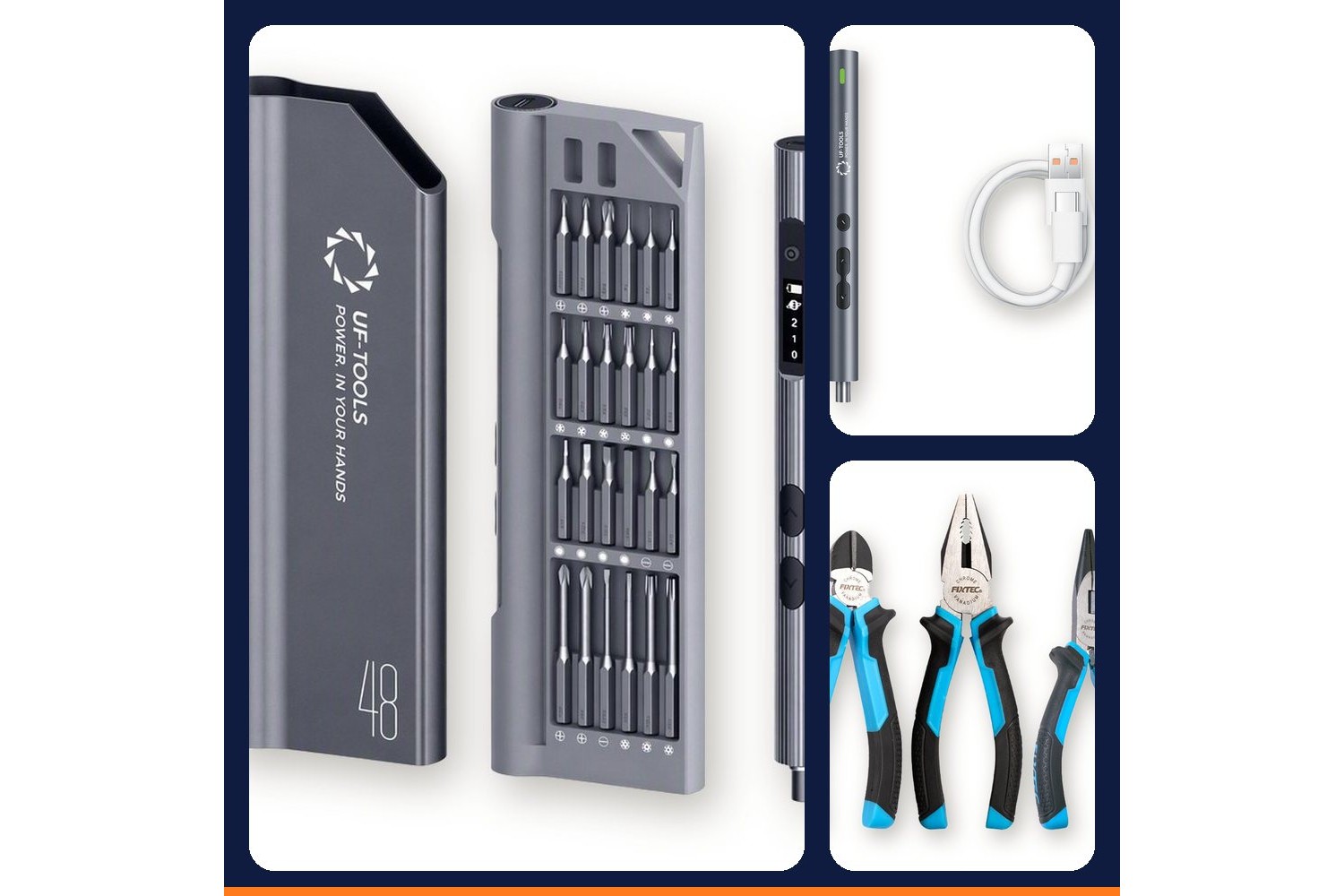
Tool sets. Some customers repair their own devices. A bit or screwdriver set under the workshop’s brand is a clear offer from people who use tools every day. See the ‘Screwdrivers’ category.

A bit set with a magnetic holder – a product under the workshop’s brand for customers who do their own repairs.
Three levels: logo, packaging, OEM/ODM
Logo on finished goods. You choose the items and the manufacturer applies the mark – by printing, engraving or embossing, depending on the material. This is the fastest route and a convenient test of demand. Terms are set out on the Private Label page; branding is available for more than 8,000 items.
Your own packaging. A retail box in your design with labelling for your market, plus hand-back packaging: bags, envelopes and boxes for repaired devices. From this point the display looks like one brand’s range.
OEM/ODM. A product made to your requirements: cable length and colour, set contents, case material. Move to this level once the core items sell steadily. Details are on the OEM/ODM manufacturing page.
Name and trade mark
Most often the accessory brand is the name of the workshop itself. Check that it is legible at small size on a plug and a cable tie, and prepare a simplified single-colour version of the mark.
A trade mark is registered with a national office or with the EUIPO for the whole EU; check the name in open databases before ordering a batch. The rule of this niche: do not use device manufacturers’ names and logos as part of your brand or design. Stating which model a protector or case is intended for is fine; giving the impression that it is the manufacturer’s original accessory is not. Procedure and cost depend on the office; if in doubt, consult a trade mark attorney.
Packaging and labelling
A repair shop has two kinds of packaging. Retail packaging sells the product on display: it needs the model or standard, specifications and space for a barcode. Hand-back packaging accompanies the repaired device: a bag or box with the mark, contact details and a space for the job number. It is useful to enclose a card with the repair warranty terms – the period and procedure are set by national rules. Do not put customer details on the packaging: the job number is enough.
Labelling is the brand owner’s responsibility. Under the EU General Product Safety Regulation, the product or packaging shows the details of the manufacturer and the responsible person in the EU. Cables, adapters and charging accessories are electronics: they need the CE marking and compliance with EU requirements, including RoHS; products with batteries are subject to separate requirements. Do not print specifications that are not backed by documents, such as charging power. Request documents from the manager before payment.
From sample to batch
- Complete the wholesale registration and send an enquiry: items, quantities, method and position of the mark, types of packaging.
- A sample or a small trial batch is by agreement with the manager. Test cables and adapters on your own devices, and protectors and cases on the models they are ordered for.
- Prepare the artwork: logo in vector format, dimensions, colours, dielines for boxes and bags, texts in the language of the country of sale.
- Approve the artwork and the quotation; then comes the pro forma invoice and payment by bank transfer in EUR or PLN.
- Production: goods, branding, packaging.
- Quality control before dispatch: function, position of the mark, completeness, print on the packaging.
- Dispatch and a tracking number. The indicative lead time is 20–60 days plus time for artwork and production; terms are on the delivery page.
What the budget consists of, and common mistakes
The budget is made up of the goods themselves, branding, retail and hand-back packaging, design of the mark and artwork, trade mark registration, delivery quoted per consignment, and fitting out the display. The minimum order value is EUR 500 net per item; an order under your own brand starts at EUR 5000; the unit price depends on the volume tier. Plan the first batch as a test: a few fast-selling items and one type of hand-back packaging.
What to avoid:
- a mark or packaging resembling device manufacturers’ designs;
- protectors and cases for rare models: they will stay in stock;
- specifications on the packaging without supporting documents;
- ordering a batch without testing the sample on real devices;
- too wide a range in the first batch;
- a late start before December: a branded order goes out no later than early autumn.
Frequently asked questions
Where to start on a small budget?
With hand-back packaging and one or two fast-selling items, such as a cable and a cable tie with the mark. Every customer receives or sees them.
Can screen protectors be branded?
Usually the protector’s packaging carries the brand, not the glass itself. Confirm the available items, models and design with the manager in your enquiry.
From what quantity can branding be ordered?
Branding terms depend on the product and method – they are confirmed in the enquiry. An order under your own brand starts at EUR 5000; other orders start at EUR 500 net per item.
Who is responsible for the quality of an accessory under my brand?
Towards the buyer, you are – as seller and brand owner; the extent of the obligations is set by national law. That is why the sample is checked before the batch and documents are requested before payment.
Choose a few fast-selling items in the ‘Repair service centres’ section, prepare a simplified mark and the hand-back packaging artwork, and start with a small batch. If the workshop is still at the planning stage, first read the article ‘How to open a phone and device repair shop’.
