
A car accessory shop starts with one question: what does the customer want to change in the car? Tidy the cabin, protect the upholstery and floor, fit a camera or a new stereo. There are no repairs or spare parts here – this is a trade in convenience, and it can be entered with a small range. Below: how to choose a format, build the first range and place an order without surplus stock.
In brief
- The range splits into universal items (organisers, holders, seat cushions, universal covers) and model-specific ones (mats and covers for a particular car); universal is the easier start.
- The format – a unit next to a car wash or in a shopping centre, an online shop, a marketplace – sets the depth of the range and the share of bulky goods.
- Car electronics (cameras, parking sensors, stereos) raise the basket value but require documents and the ability to explain fitting.
- Bulky items – mats, seat cover sets – noticeably affect the delivery cost, which is calculated per consignment.
- Delivery takes an estimated 20–60 days; winter and summer ranges are ordered 2–3 months ahead.
Customer and format
There are three types of buyer. The owner of a newly bought car, new or used, takes everything at once: mats, covers, an organiser. The driver who spends all day at the wheel – taxi driver, courier, sales rep – replaces what has worn out and values practicality. The third is choosing a gift and needs a clear product in neat packaging.
A physical shop works where car traffic already exists: by a car wash, a tyre fitter, a petrol station, in a shopping centre car park. Its strength is that goods can be handled and held against the seat and, by arrangement with a garage, a camera or parking sensors can be fitted straight away. In an online shop and on Amazon or eBay the listing decides everything: dimensions, material, fit by body type and year, photos in the cabin. Bulky goods sold online call for packaging and delivery to the customer to be planned in advance.
Companies are a separate channel. Used car dealers equip vehicles before sale, taxi firms and car-sharing operators regularly renew covers and mats, car washes and detailing studios sell accessories to their own customers. They care about invoices, consistent batches and predictable lead times.
Starting range: core items and trial items
Seat protection. Seat covers include universal five-seat sets, front seat cushions and protective covers for transporting pets. A universal set fits most cars and does not tie stock to one model, which is why it comes first.

Universal five-seat set: one item answers the needs of owners of different cars.
Floor protection. Floor mats are either universal or model-specific. Custom-fit TPE mats with raised edges follow the floor shape exactly and sell at a higher price, but each car model is a separate stock item. Draw up a short list of cars common in your area and take sets only for those.

An example of a model-specific item: the set follows the floor of one particular car and suits only its owners.
Order in the cabin. Organisers for the boot, the seat back and the gap by the console, phone holders, hooks and nets are inexpensive universal goods bought without much deliberation. They form the core of the display and the till area.
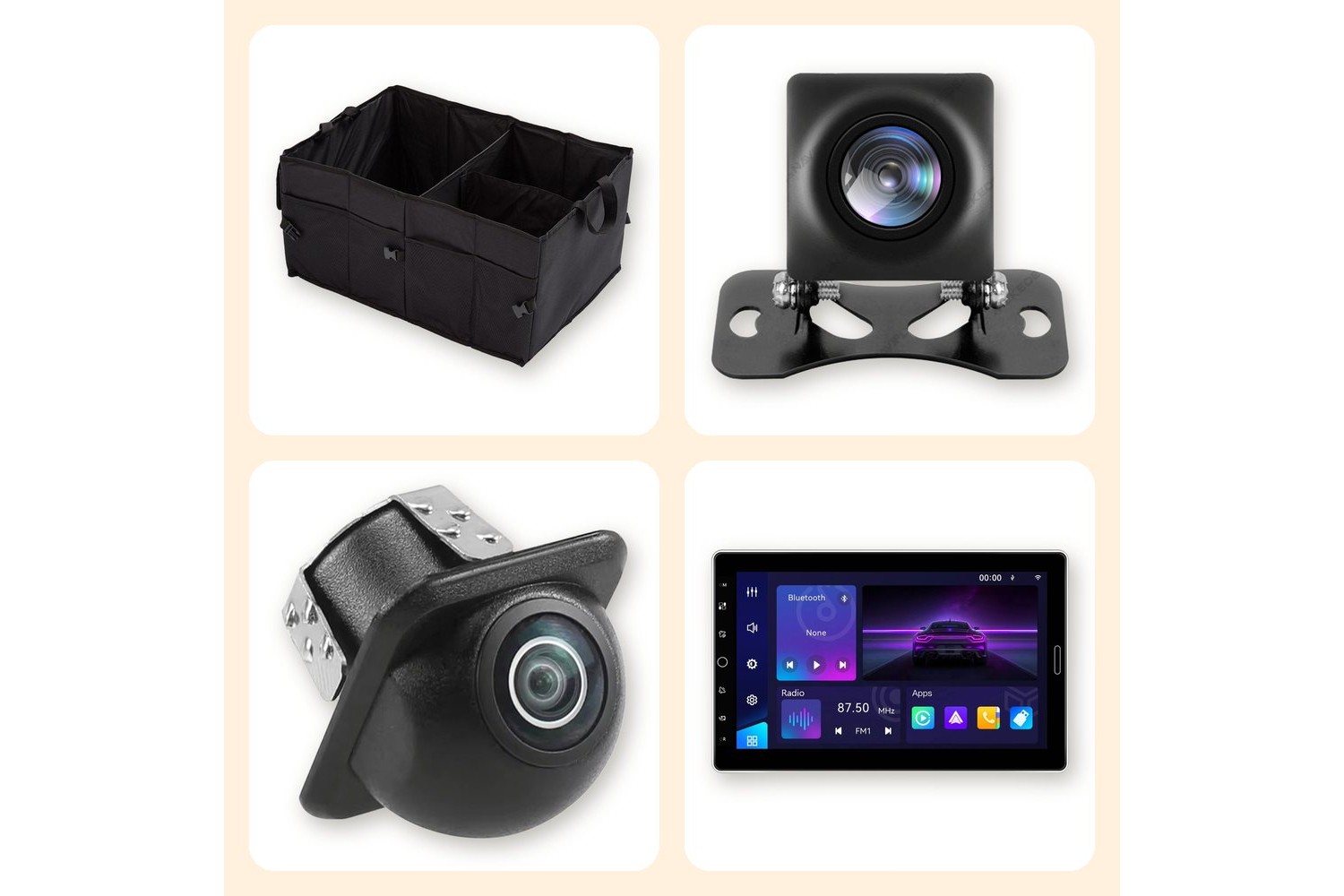
Electronics. Reversing cameras, parking sensors and stereos are worth taking on trial, a few models of each. Staff will have to answer questions about mounting, 12 V power and compatibility with the head unit, but the basket value is higher.

Water-protected reversing camera – an easily understood upgrade for a car without a factory camera.

Parking sensors with display and voice alert: an item that sells well together with fitting at a partner garage.
Small care items – microfibre cloths, brushes, ice scrapers – round off the range and give a reason to come back. Fast-moving items by season are covered in the article on the seasonal and year-round car accessory range.
What the starting budget consists of
The amounts depend on the format and the width of the range, but the structure of spending on goods is similar for everyone:
- universal part: organisers, holders, cushions, universal covers and mats;
- model-specific part: mats and covers for the chosen list of cars;
- electronics: a few models of cameras, parking sensors and stereos;
- delivery – a significant item for bulky goods, calculated per consignment;
- shop fittings: mat stands, a demonstration seat, a display with a connected camera;
- a reserve for reordering whatever sells faster than expected.
Rent, registration, the till and advertising are budgeted separately. The first order should not cover the full width: fewer lines with several weeks of stock, and money kept for a repeat order, work better.
Supplier and first order
EnjoyCommerce supplies goods to companies and entrepreneurs in EU countries. The minimum order value is EUR 500 net per item, so the first range can be assembled as one order of several items, each from EUR 500 net.
- Read the buyer’s guide and complete the wholesale registration: after that, net prices by volume tier become visible.
- Draw up a list: product type, car model for model-specific items, colour, quantity. Send the request – the manager prepares a quotation and calculates delivery for the consignment.
- Agree the quotation and receive a pro forma invoice. Payment is by bank transfer in EUR or PLN.
- The goods are dispatched or produced and pass quality control before shipment.
- After dispatch you receive a tracking number and documents. Build the delivery terms into the opening plan: the estimate is 20–60 days.
Invoices are issued by a Polish company with an EU VAT number. For EU companies with a valid EU VAT number, an intra-Community supply (reverse charge) is possible; your accountant will advise how to record it.
Documents and product requirements
Business registration, taxes and trading rules depend on the country – check them with an accountant or the local authority. Product requirements are common across the EU. Cameras, parking sensors, stereos and other electronics must carry the CE marking and meet RoHS requirements. Ask the manager for certificates and declarations before payment, not after the consignment arrives.
Under the General Product Safety Regulation (GPSR), the product or packaging shows the details of the manufacturer and of the responsible person in the EU – this applies to covers and organisers too. Two practical questions should be asked before ordering: are the front seat covers compatible with side airbags, and does the driver’s mat have fixings that stop it sliding towards the pedals? One more point: stating which model an item fits is allowed, but placing car makers’ logos on the product or packaging is not.
Seasonality and the purchasing calendar
Demand comes in two waves. Towards autumn and winter customers buy mats with high edges, seat cushions, ice scrapers and brushes; the order for these is placed in midsummer. Towards spring and summer sales grow for boot organisers, holders, sun shades and covers for transporting dogs – everything taken on trips; this consignment is ordered at the end of winter.
The third point is December: accessories are popular gifts, and the gift consignment is ordered in early autumn. Seasonal goods are ordered 2–3 months ahead, so it pays to draw up a purchasing calendar for the whole year and check it against the lead time.
Typical mistakes at the start
- Buying model-specific mats for dozens of cars: rare ones sit unsold while money for the popular ones runs out.
- Overlooking volume: mats and seat cover sets take up a lot of space in storage and in transit.
- Selling electronics without documents and without an answer to who will fit them.
- Leaving exact fit and dimensions out of the listing – the main source of returns in online sales.
- Placing the winter order in October and receiving the goods at the end of the season.
Frequently asked questions
What amount is enough to start buying?
The minimum order value is EUR 500 net per item. It can be a combined consignment: a small shop tests demand with a few lines, each from EUR 500 net.
What comes first – universal or model-specific goods?
Universal. They fit most cars and do not date when model line-ups change. Add model-specific mats and covers for the cars customers ask about most often.
Which documents are needed for car electronics?
Documents confirming the CE marking and RoHS compliance. The manufacturer provides them on request; ask the manager to send them before payment and keep them with the consignment paperwork.
Does the shop have to fit cameras and parking sensors itself?
Not necessarily. Many shops have an arrangement with a nearby garage and refer the customer there. What matters is that staff can explain what the kit contains and what kind of fitting it needs.
Decide on the format, split the range into universal and model-specific parts and choose items in the section goods for car accessory shops. Once it is clear what sells steadily, those products can be released under your own name – see the article on building your own car accessory brand.
