
A scarf and glove shop starts with the calendar. Most of the turnover comes from a few cold months, and the stock has to be on the shelf by the first cold snap. The second decision is what to sell in the warm part of the year: light scarves and neckerchiefs sell in spring and summer and keep the outlet trading. Below: how to choose a format, build a range by material and size, and order the first batch in time for the season.
In brief
- Sales peak in autumn and winter; the winter collection is ordered in summer, 2–3 months before selling starts.
- The range is built by purpose: warm knitwear, light scarves, gift sets.
- Gloves are a sized product: decide early whether to stock one-size models or a size run.
- Fibre composition is stated precisely: satin is a weave, not a raw material.
- The minimum order value is 500 EUR net per item, so the first range can be put together from several items.
Customers and sales format
People buy for three reasons. The first is the weather: someone needs gloves or a scarf today, chooses quickly and looks at warmth, price and fit. The second is a gift: scarves and gloves are given to people whose clothing size is unknown, and packaging and a ready-made set decide the sale. The third is the outfit: a scarf to go with a coat, a bag or a hairstyle is bought all year round and chosen by its pattern. A separate group is companies, clubs and schools that need identical items in quantity, often with a logo.
The goods are compact, so a kiosk in a shopping centre or a small unit suits this niche: a few metres hold many lines, and the main selling tools are a colour-blocked display and a mirror. A seasonal outlet is also an option: the space is rented for autumn and winter only, or you take a stall at a Christmas market. For an online shop and for marketplaces such as Amazon, eBay or Etsy, scarves and gloves are convenient because they are light, unbreakable and cheap to post. The listing should state the composition, the length and width of the scarf, the hand circumference for gloves, and show the item being worn: this drives the return rate.
Starter range: core lines and trial lines
Gloves. The core of the winter range is one-size knitted gloves: the knit stretches, the model fits most customers and needs no size run. Touchscreen fingertips are now an expected feature rather than an extra: nobody wants to take a glove off to answer a call.

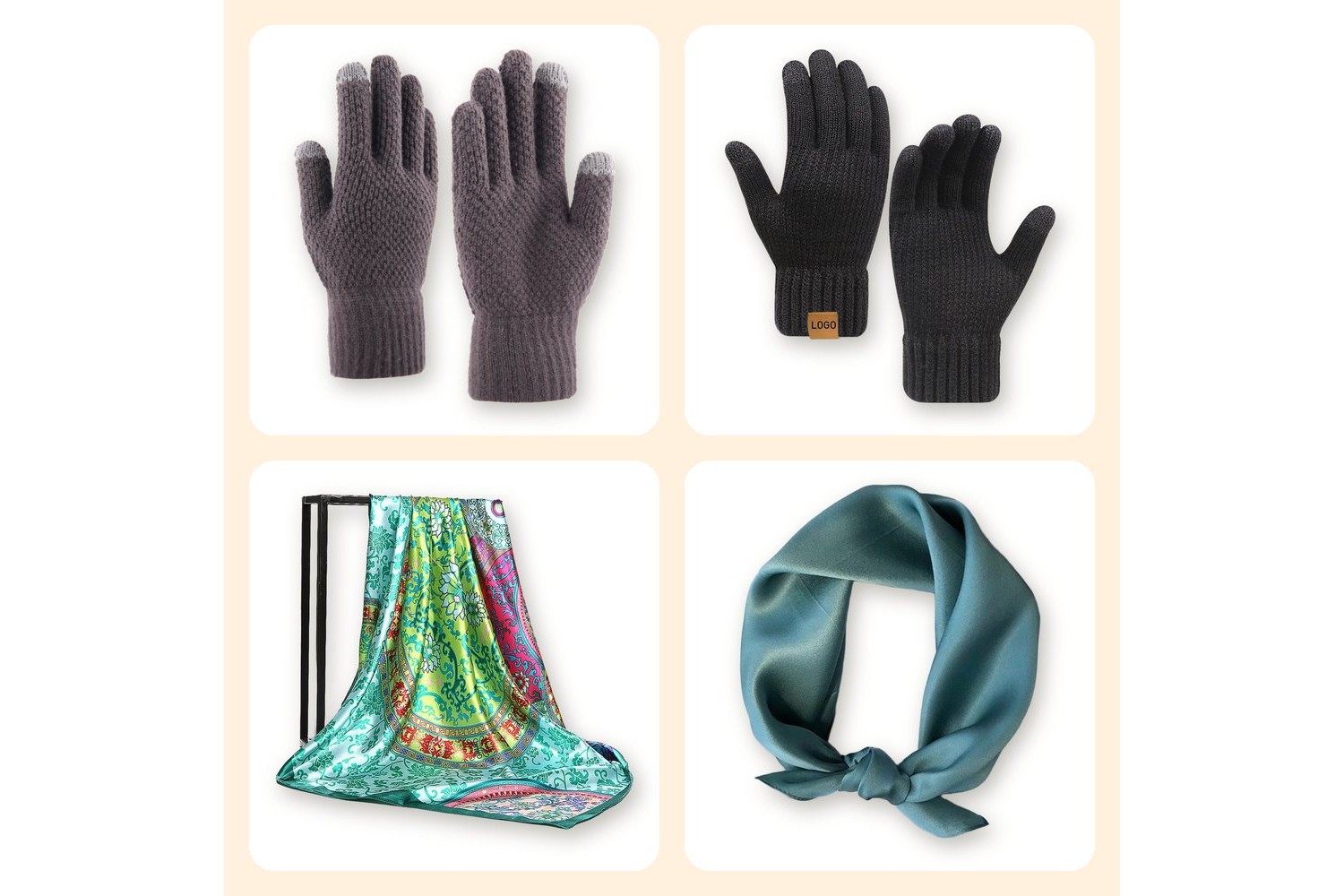
Unisex knitted touchscreen gloves in four colours: a core line with no size run for the first winter range.
The second tier is lined models for freezing days. They sell in smaller numbers, but they are what customers ask for when thin gloves stop keeping hands warm.

Warm gloves with touchscreen fingers: the warmer tier of the range, and the patch is useful for corporate orders.
If you take sized models (S, M, L or by hand circumference), order more of the middle sizes and fewer of the end sizes, and plan men's and women's models separately. Add mittens and fingerless gloves as trial lines.
Scarves and shawls. The warm part of the group is knitted scarves, snoods and wraps: keep a calm core palette (black, grey, beige, navy) and a few bright colours on trial. The light part is printed scarves: they sell outside the cold months and work well as gifts.

Satin square scarf 90×90 cm with digital print: a line for spring and summer and a ready gift in a flat box.

Neckerchief with custom print: an inexpensive accessory for the till area and for sets with a bag.
Put sets together yourself: a scarf and gloves in one colour story and in shared packaging sell for more than the two items separately and answer the question of what to give. The lines that shops in this niche order most often are covered in the article on the wholesale range for a scarf and glove shop.
What the start-up budget consists of
The amounts depend on the format and the town, but the structure of stock costs is much the same everywhere:
- the core winter range: gloves and scarves in calm colours with depth in the fast sellers;
- trial lines in small quantities: bright colours, mittens, patterned scarves;
- gift packaging: boxes, ribbons, bags;
- delivery, which is calculated for the specific batch;
- display equipment: hooks, stands, display hands, a mirror;
- a reserve for reordering in season and for marking down leftovers in spring.
Rent, registration, the till and advertising are budgeted separately. The particular feature of this niche is that the money goes out in summer and comes back from October to February. Build that gap into the plan.
Supplier and first order
EnjoyCommerce supplies companies and sole traders in EU countries. The minimum order value is 500 EUR net per item, so gloves, scarves and neckerchiefs can go into one order, each item from 500 EUR net.
- Read the buyer's guide and complete wholesale registration: net prices by volume tier become visible afterwards.
- Draw up a list: model, colour, size, quantity. The manager prepares a quotation and calculates delivery for the batch.
- Agree the quotation and receive a pro forma invoice. Payment is by bank transfer in EUR or PLN.
- The goods are dispatched or produced and go through quality control before shipping. Ask for colour consistency across the batch, dimensions, seams and the touchscreen fingers to be checked.
- After dispatch you receive a tracking number and documents. Put the delivery times and terms into your calendar: delivery takes an estimated 20–60 days.
Invoices are issued by a Polish company with an EU VAT number. For EU companies with a valid EU VAT number, an intra-Community supply (reverse charge) is possible; your accountant will advise how to record it.
Documents and product requirements
Business registration, taxes and trading rules depend on the country; check them with your accountant or the local authority. Product requirements are common across the EU. Under the General Product Safety Regulation (GPSR), the product or its packaging carries the details of the manufacturer and of the responsible person in the EU. Textile products carry the fibre composition in the language of the country of sale; customers also expect care instructions on the label.
Name materials as they appear in the composition. Acrylic is not wool and polyester satin is not silk; the words "wool", "cashmere" and "silk" may be used only where the composition confirms them. If you take children's models, remember that requirements for children's products are stricter, for example for cords and drawstrings. Ask the manager for documents on composition and conformity with EU requirements before payment.
Seasonality and the buying calendar
The year falls into two unequal parts. Warm items sell from the first cold days to the end of winter, with a peak before Christmas, when scarves and gloves are bought as gifts. For the stock to be on the shelf at the start of autumn, the order is placed in early summer: seasonal goods are ordered 2–3 months ahead, and time for receiving and displaying the stock should be added to the delivery time.
A mid-season reorder only makes sense for stock that will arrive before the cold ends; in January the winter range is no longer replenished but sold through. Light scarves are ordered in winter, for spring and Mother's Day. In summer they remain the basis of the display while the next winter order is prepared.
Common mistakes at the start
- Ordering winter stock in September: the batch arrives when the season is already under way.
- Ordering sized gloves evenly across all sizes and being left with the end sizes.
- Buying bright colours without a core: black and grey sell out first.
- Describing synthetics as wool or silk in the listing and receiving complaints.
- Planning nothing for the warm months and closing the outlet for half the year.
Frequently asked questions
What is the smallest amount I can start with?
The minimum order value is 500 EUR net per item. It can be a combined batch, so gloves, scarves and neckerchiefs are ordered together.
One-size gloves or a size run?
At the start, one-size knitted models are simpler: they stretch and leave no leftover sizes. Sized models are added once you know your customers, with more of the middle sizes ordered.
What sells in summer?
Light patterned scarves and neckerchiefs, wraps for cool evenings, gift sets. Turnover will be lower than in winter, but the display stays alive and customers remember the outlet when autumn comes.
Can I order a trial batch before the season?
A sample or a small trial batch is available by agreement with the manager. It is worthwhile in this niche: the softness of the yarn, the density of the knit and the colour of the print are best judged in the hand, ideally in spring, before the main order.
Decide on the format, put the date of the summer order in the calendar and choose items in the section of goods for scarf and glove shops. Once it is clear which models sell steadily, they can be sold under your own name; that is the subject of the article on building your own scarf and glove brand.
