
A car repair workshop starts with the list of jobs you will do, not with buying equipment. Everything else depends on the services: the floor area and height of the unit, the number of bays, lifts, tools, staff requirements and permits. A general garage, a tyre fitting centre and a quick oil-change point are equipped differently. Below: how to choose a format, put together equipment bay by bay, what to buy wholesale and what to settle in the paperwork before opening.
In brief
- Services and number of bays first, equipment second: a spare machine does not pay for itself, and a shortage of spanners stops work.
- Large fixed equipment is bought with installation and servicing; hand and power tools, compressors, jacks and workwear are convenient to buy wholesale.
- Tools are counted per bay and per mechanic, not “for the garage”.
- Permits, waste handling and health and safety are governed by national rules – find them out before renting premises.
- The minimum order value is 500 EUR net per item and delivery takes roughly 20–60 days: order the equipment before the unit is fitted out, not after.
Customer and format
Workshop customers fall into three groups. Private owners come for servicing and routine repairs and choose by location, reviews and turnaround. Business customers – delivery firms, taxis, small fleets – value speed and predictability and provide steady work. The third group is seasonal tyre-change customers: twice a year they form a queue.
Formats differ in how much it takes to get in. A small garage with one or two bays does servicing and simple repairs. A specialist workshop focuses on one area: tyres, suspension, electrics, bodywork, air conditioning. A general garage with several bays needs a large floor area, lifts and diagnostic equipment. A separate format is the mobile mechanic: a tool kit in the van and work at the customer’s site. The narrower the specialism, the smaller the starting set of equipment and the easier it is to explain why customers should come to you.
Starting equipment
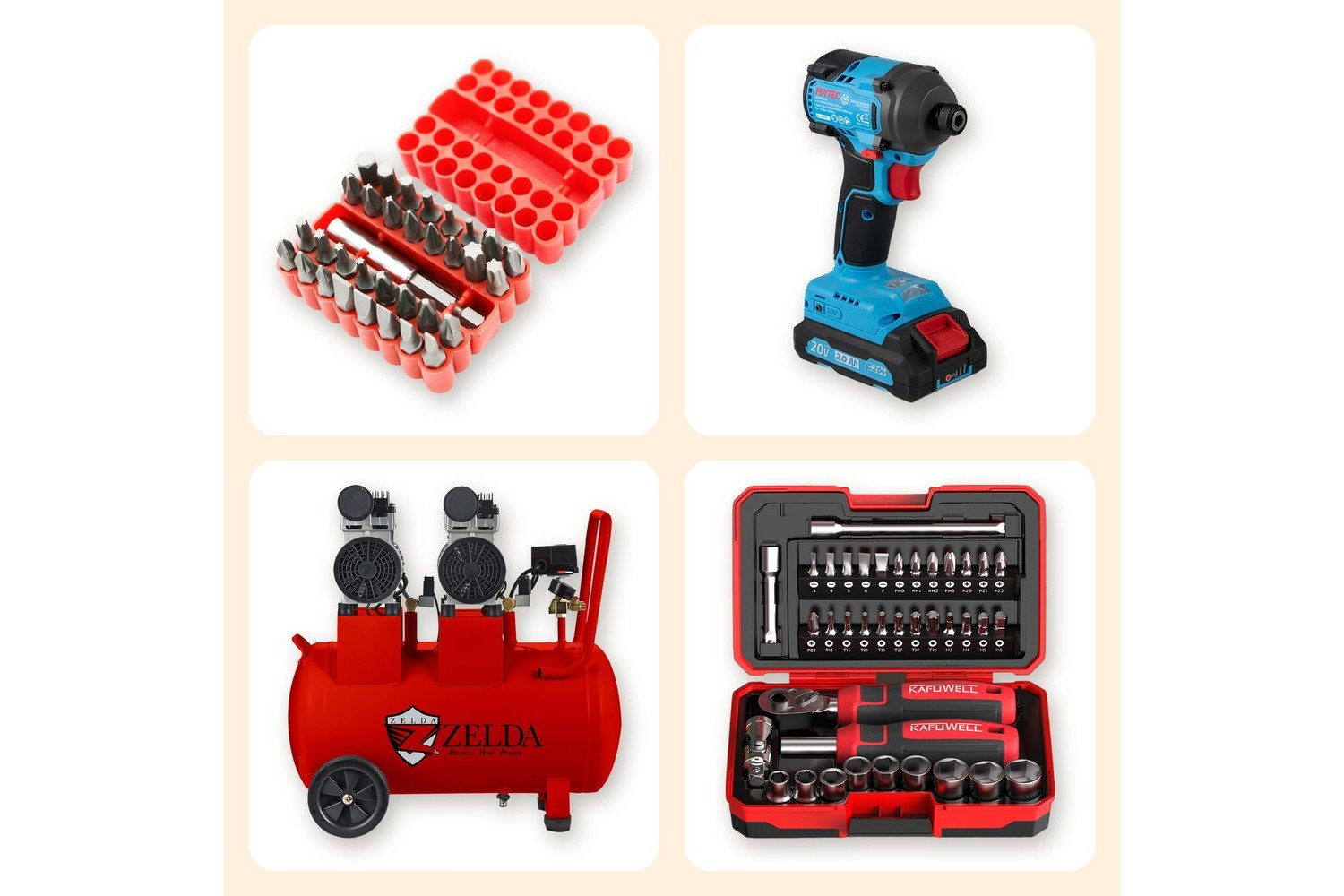
It helps to split the equipment into four layers. What such a workshop usually buys is shown in the selection “Top wholesale products for auto service centres”.
Fixed equipment. Lifts, a tyre changer and wheel balancer, test benches and diagnostics are chosen to match the service list and bought from suppliers who handle installation, training and later servicing.
Lifting and compressed air. Even with a lift, a bay needs trolley and bottle jacks – for tyre fitting, raising an axle and work in the yard.

A 2-tonne trolley jack is a basic item for the bay and for call-outs to passenger cars.
Compressed air is needed for inflation, blow-down and air tools. Output and tank size are chosen by the number of simultaneous users; see the “Compressors” category.

A 50-litre oil-free compressor on a 220 V supply covers inflation and blow-down in one bay.
Hand tools. The basis of every bay is socket sets, ratchets, combination spanners, screwdrivers, pliers and hammers. A set is counted per mechanic: shared tools go missing and cause downtime.

A compact 1/4" socket and bit set with ratchet in a case – for interior work, under the bonnet and call-outs.
Workwear and protection. Trousers, jackets or overalls, gloves, glasses and toe-cap footwear are not a uniform for show but a safety requirement. Clothing is in the “Workwear” category, boots in the work footwear section.

Work boots with a steel toe cap and puncture-resistant insole are essential foot protection beside the lift.
Consumables include bits, cutting and grinding discs, gloves, wipes, clamps and insulating tape. They are bought with a margin: they cost little, but running out stops the bay.
What the starting budget consists of
The amounts depend on the format, the town and the state of the premises, but the structure is the same:
- business registration, permits and approvals – under national rules;
- rent and preparation of the unit: floor, ventilation, power supply (powerful compressors and lifts need three-phase), lighting, drainage and oil separators where local rules require them;
- fixed equipment with installation and commissioning;
- tools by bay, compressed air, jacks, tool trolleys and workbenches;
- workwear and protective equipment for every worker;
- the first stock of consumables;
- waste collection contracts, job management software, signage and advertising;
- a reserve for wages and rent in the first months while the customer flow builds.
Supplier and first purchase
- Complete the wholesale customer registration to see net prices by volume tier.
- Draw up a specification by bay – tools, compressed air, jacks, workwear by size – and send a request. The ordering process is described in the buyer’s guide.
- The manager sends a commercial offer with prices, lead time and delivery cost quoted per shipment: heavy items such as compressors affect it noticeably.
- Once agreed, you receive the pro forma invoice and pay by bank transfer in EUR or PLN.
- The goods are shipped or produced; before dispatch they go through quality control.
- You receive a tracking number and documents; the indicative lead time is 20–60 days.
Invoices are issued by a Polish company (EU VAT); for EU companies with a valid EU VAT number, intra-Community supply under the reverse charge is possible. The minimum order value is 500 EUR net per item, so a kit for two or three bays is easy to put together in one order.
Documents and requirements
A car repair workshop is a regulated activity, and the rules depend on the country and municipality. Before signing a lease, find out from the local authority and your accountant whether the activity is allowed in those premises, which notifications or permits are needed and whether certain jobs require qualifications. Air-conditioning servicing, for example, involves refrigerants and requires certified staff.
Environment. Used oil, filters, brake fluid and coolant, batteries and tyres are waste that must not go out with general rubbish: they are stored separately and handed to specialist companies under contract, and the transfer is recorded. The procedure and reporting are set by national law.
Health and safety. The employer assesses risks, trains workers and issues protective equipment. Lifts and pressure vessels, including compressor tanks, are subject to periodic inspection under local rules.
Goods. Power tools and compressors must carry CE marking, and personal protective equipment needs conformity documents. Request declarations and certificates from the manager before payment and confirm the voltage and plug type.
Seasonality and purchasing calendar
A workshop has two marked peaks – the spring and autumn tyre changes. Jacks, compressed air, consumables and extra hands are prepared for them in advance. In summer, demand grows for air-conditioning servicing and pre-trip checks; in winter, for batteries, starting problems and suspension. Given the lead time, equipment for the autumn season is ordered in early summer and for spring in winter. Workwear is renewed before the cold season: lined items are needed before the first frosts.
Typical mistakes at the start
- Renting a unit without checking ceiling height, power supply capacity and whether the activity is permitted there.
- Buying equipment “to grow into” for services with no demand yet.
- Saving on hand tools: one set between three means a queue at the toolbox.
- Not signing oil and tyre collection contracts before opening.
- Forgetting workwear and footwear in the right sizes for every worker.
- Choosing a compressor with no margin of output.
Frequently asked questions
Can you start with one bay?
Yes. One bay with a narrow list of jobs – servicing, brakes, tyre fitting – lets you test the location and demand. A second is added when a queue appears.
Which equipment can be ordered wholesale from one place?
Hand and cordless tools, compressors, jacks, consumables, workwear and footwear. Lifts and machines that need installation are usually bought from specialist suppliers.
What compressor does a small workshop need?
It depends on the air tools. For inflation and blow-down a compact model on a domestic supply is enough; for impact wrenches and several bays you need a larger tank and output with a margin, often on a 380 V supply.
How many tool sets should you buy?
One basic set per mechanic plus shared special tools for the workshop. Popular socket sizes and bits are worth buying with spares: they wear out and go missing first.
Write the list of jobs, spread it across the bays and put together a specification in the “Auto service centres” section. Once the workshop is running, it is worth thinking about recognition – see the article “Branded products for a car workshop”.
