
A lighting shop starts with a decision about who your customer is and which space they are lighting: a flat, a house with a garden, a café or an office. That determines the display, the depth of stock and the sales channel. After that you need three things: a short starting range, a supplier who can provide product documents, and enough time for the first delivery.
In brief
- People buy light for a specific room and interior, so build the range by room and style rather than stocking a little of everything.
- Ceiling and wall fittings and table lamps are the core of sales; chandeliers and floor lamps raise the average order, while night lights and decorative lamps are impulse and gift purchases.
- Large chandeliers take up space and need careful transport: one or two models per style are enough at the start.
- Light fittings are electrical goods: ask your account manager for CE marking and documents before you pay.
- Delivery takes an estimated 20–60 days, so the autumn season is prepared in summer.
Customer and format
A lighting shop has three typical customers. The first is renovating or moving home: they need a set for the whole flat, compare dimensions, lamp bases and colour temperature, and come back for whatever is missing. The second is refreshing one room or looking for a gift – a table lamp, a night light, a decorative piece – and decides quickly from a photo. The third is a business: cafés, salons, small hotels, interior designers. They order identical models in quantity and value being able to reorder later.
Choose the format to suit the customer. A physical showroom offers what the internet cannot: the light can be switched on so the shade and brightness are visible. But a display of wired-in samples needs floor space and installation. An online shop, or selling on Amazon or eBay, is easier to launch with compact goods – table lamps, night lights, wall lights that travel well. Large glass and crystal chandeliers need care online: packaging and delivery to the door become part of the product. Work with designers and venues is usually added in a second phase, once it is clear which models can be reordered reliably.
Starting range: core lines and trial lines
Ceiling lighting. This is what brings customers in after a renovation. The core should include chandeliers in two or three styles – modern, classic, neutral – and in several diameters, to cover both a small bedroom and a living room. For each model, record the dimensions, fixing method and whether it has a remote control and dimmer: these are the first questions customers ask.

A ceiling chandelier with remote control – a living-room model that shows how the higher-value end of the display performs.
Spot and wall lighting. Light fittings for hallways, kitchens, bathrooms and work areas are bought several at a time, and they are what generates repeat sales. What matters here is the protection rating for damp rooms and a consistent light tone across a series.
Floor and table lighting. Floor lamps and table lamps need no installation, so people buy them without renovating – for a rented flat, a study, a gift. This is the easiest group to sell online and to test demand with a small batch.

A floor lamp with a touch dimmer: light that needs no electrician and moves from room to room.

A cordless table lamp in several colours – a line for the till-side display and for online sales.
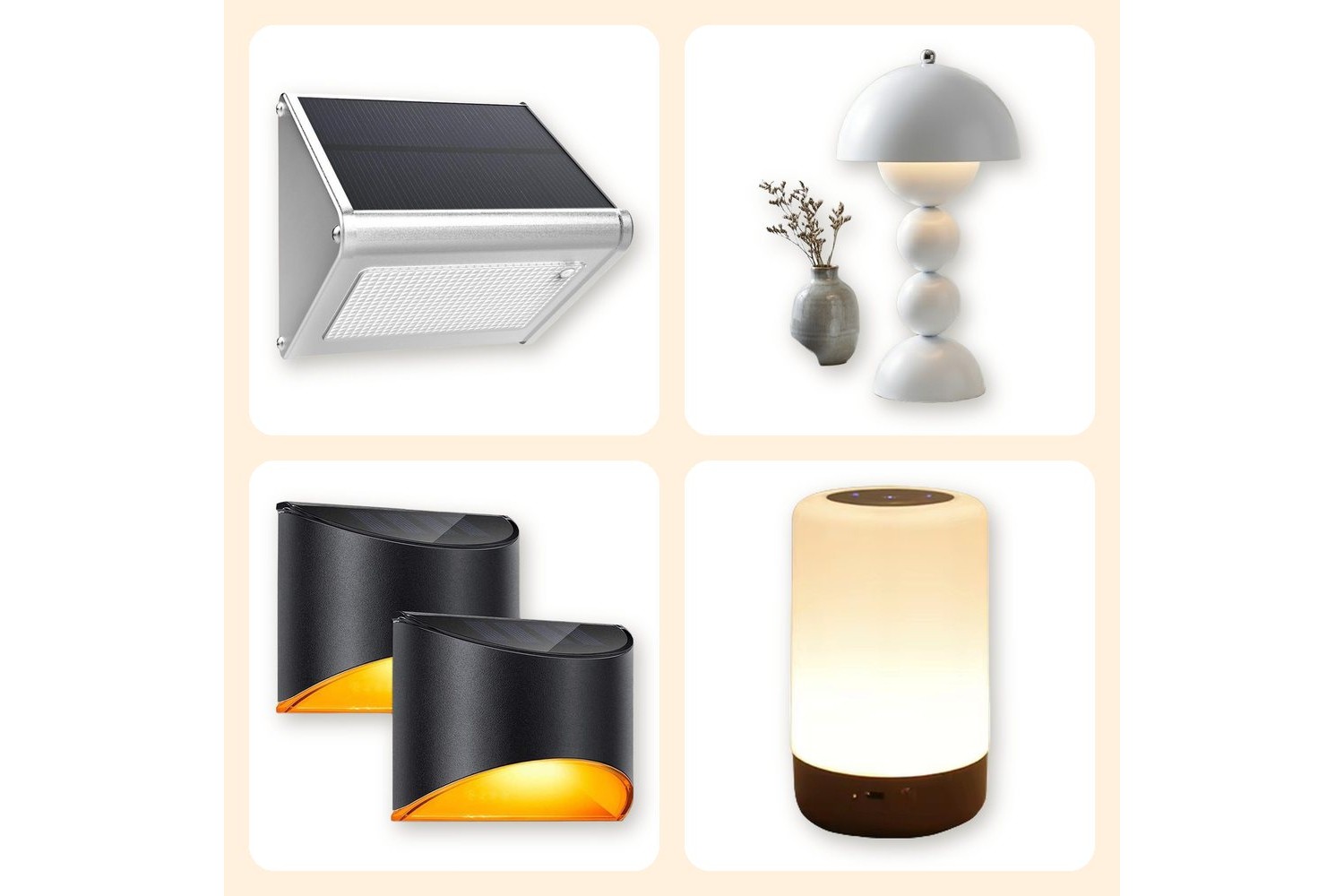
Decorative lighting on trial. Take night lights, unusually shaped lamps and rechargeable models for the terrace in small quantities and watch what sells. Outdoor lighting for gardens and façades is a separate line: it is worth starting with only if homeowners are among your customers, and then a few models from the solar lights category are enough.

A quartz night light on a wooden base: a gift line that sets the display apart from a DIY store.
An example of a ready-made list with the reasoning behind it is in the article on a first wholesale order of lighting.
What the starting budget consists of
The amounts depend on format and location, but the cost items for the stock itself are the same for everyone:
- the first batch: core models with a reserve, and trial models a few units each;
- display samples that will hang switched on and cannot be sold as new;
- delivery – the cost is calculated for the specific consignment, and large chandeliers take up a lot of volume;
- shop fittings: ceiling rails, stands, wiring for connecting samples;
- bulbs and consumables for demonstration;
- shipping packaging, if you sell online;
- a reserve for breakage, returns and reordering what sells out early.
Rent, fit-out, staff, website and advertising are budgeted separately. In the purchasing spreadsheet it helps to note the room each model is intended for – you see at once where the range is lopsided.
Supplier and first order
EnjoyCommerce supplies goods from China to companies and sole traders in EU countries. The minimum order value is 500 EUR net per item, so a first display can be put together as one order of several items, each from 500 EUR net. The steps are:
- Read the buyer’s guide and complete wholesale registration – after that, net prices by volume tier become visible.
- Draw up a list of models with quantities and send an enquiry. The account manager will prepare a quotation and calculate delivery for your consignment.
- Agree the quotation and receive a pro forma invoice. Payment is by bank transfer in EUR or PLN.
- The goods are dispatched or produced and undergo quality control before shipping.
- After dispatch you receive a tracking number and documents. It is worth reading the delivery terms within the EU before ordering, especially for fragile and bulky models.
Invoices are issued by a Polish company with an EU VAT number. For EU companies with a valid EU VAT number, an intra-Community supply under the reverse charge mechanism is possible – your accountant can advise how to record it.
Documents and product requirements
Business registration, taxes and trading rules depend on the country: check them with your accountant or the local authority. Requirements for the goods themselves are common across the EU. Light fittings are electrical equipment: CE marking is required, and products containing electronics are subject to restrictions on hazardous substances (RoHS). Models with built-in rechargeable batteries fall under battery requirements. Certificates and declarations are requested from the manufacturer through your account manager before payment.
Check the practical points at the same time: plug type and voltage, lamp base, IP rating for bathrooms and outdoor use, and instructions in the language of the country of sale. Under the General Product Safety Regulation (GPSR), the product or packaging carries the details of the manufacturer and of the responsible person in the EU. Rules on energy labelling of light sources and a seller’s obligations for collecting waste electrical equipment are implemented differently from country to country – find out what applies before your first sale.
Seasonality and purchasing calendar
Demand for home lighting rises in autumn, when the days shorten and summer renovations finish, and holds until the winter holidays. Decorative lamps and night lights sell well as gifts in November and December. Spring brings the garden and terrace season: outdoor and solar lights need to be on the shelf by March or April.
Seasonal goods are ordered 2–3 months ahead. That means the autumn display is put together in June and July, the gift range by early autumn and garden lighting in January. Reorder steady sellers by stock level rather than waiting for an empty shelf: the lead time cannot be shortened.
Common mistakes at the start
- Buying one unit of everything: the display looks varied, but there is nothing to reorder for a whole-flat set.
- Filling the stockroom with large chandeliers before the first sales.
- Not recording dimensions, lamp base and colour temperature – without them a product page does not sell and returns rise.
- Paying for a consignment without requesting documents for electrical goods.
- Economising on shipping packaging for glass.
- Ordering the autumn collection in September.
Frequently asked questions
Can a lighting shop operate online only?
Yes, if you start with compact goods: table lamps, night lights, wall lights and smaller ceiling models. Detailed photos with the light on, dimensions and specifications take the place of a showroom. Large chandeliers are added once packaging and delivery are running smoothly.
How many models are needed to start?
There is no single figure. It is easier to count by room: a few models each for the living room, bedroom, kitchen, hallway and bathroom in two or three styles, plus table lamps and night lights. The minimum order value is 500 EUR net per item, which also sets the budget for each model you add.
Which documents should be requested for light fittings?
A declaration of conformity and confirmation of CE marking, plus battery documents for rechargeable models. The request goes through your account manager before payment; plug type, voltage and the language of the instructions are clarified at the same stage.
When should stock for the autumn season be ordered?
The estimated delivery time is 20–60 days, plus time for agreeing the quotation and payment. Seasonal goods are ordered 2–3 months ahead, so the enquiry for autumn is sent in early summer.
List your rooms and styles, choose models in the lighting shop supplies section and send an enquiry for a quotation. Once you have steady sellers, some of them can be produced under your own label – see the article on building your own lighting brand.
