
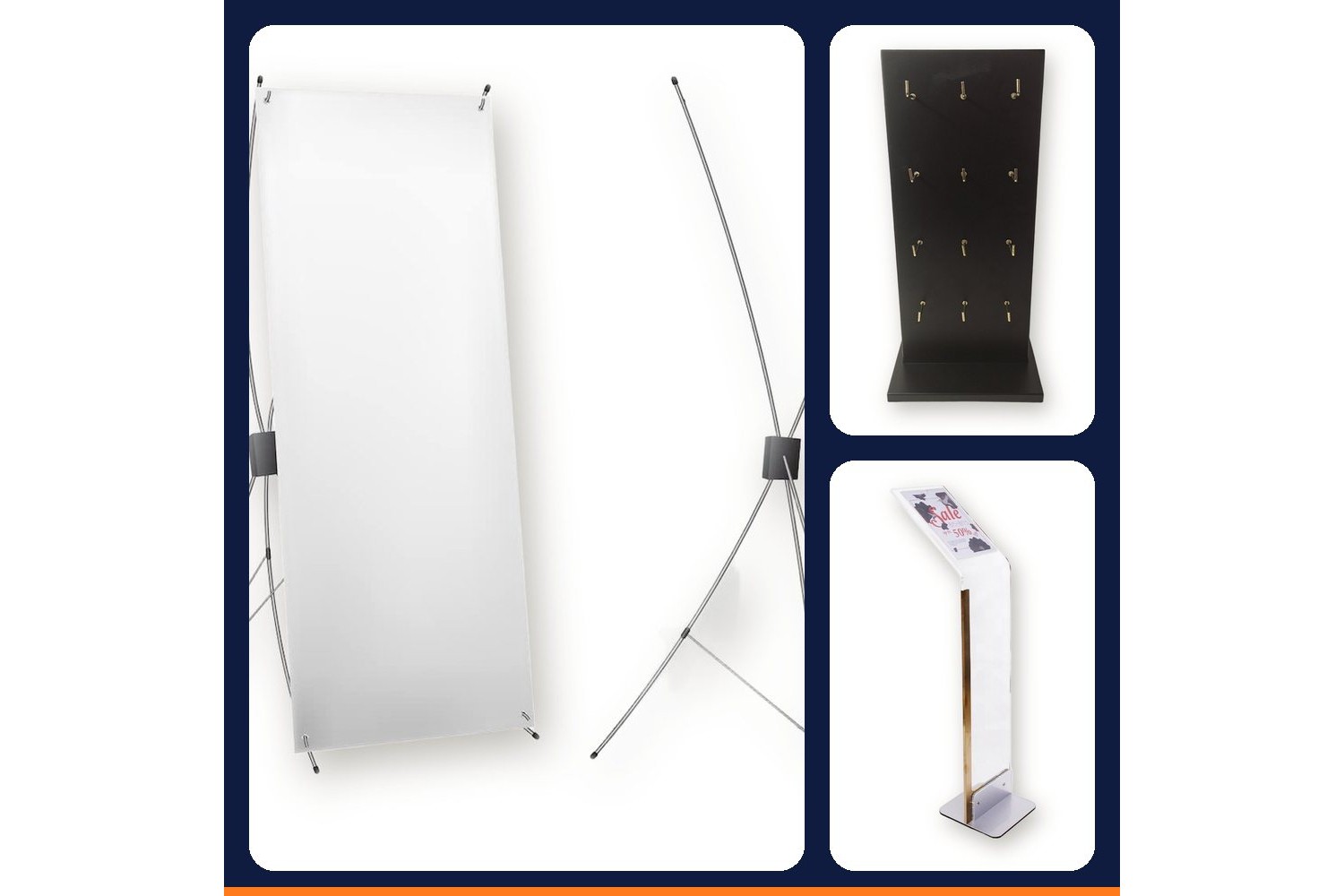
Your own retail equipment brand is best started with compact standard items: acrylic signs, poster stands, holders and displays. They are bought by businesses, and a business wants to find the same model six months later by name and item code – which is exactly the job of a brand. The first step is your own packaging, instructions and a discreet logo on a ready-made product; a design of your own comes later. Below: which items to choose, how to handle the name and packaging, and how to get from sample to batch.
In brief
- Standard items with repeat orders suit a brand: signs, stands, holders, displays.
- Three levels: a logo on a ready-made product, your own packaging, production to your requirements (OEM/ODM).
- In this niche the brand lives on the packaging, in the instructions and the item code: the equipment itself should not compete with the customer's goods.
- The name is checked for availability and registered as a trade mark – with a national office or with the EUIPO for the whole EU.
- Branding lengthens the lead time, so a batch for the opening season is planned with a margin.
Why a brand in this niche
Retail equipment on Amazon or eBay is anonymous: identical listings with a factory photo and a title made of dimensions. A business owner who has fitted out one outlet and is opening a second struggles to find the same stand – they remember neither the seller nor the model. A range name and item code on the packaging solve this, and the repeat order comes to you rather than to the listing next door.
The second reason is the system. A business fits out an outlet as a whole and wants the sign at the till, the stand at the entrance and the display on the counter to look like one set. A line in a single material and colour sells as a set, and a set is harder to compare on price than a single item. The third reason is the buyer's trust: instructions, a dimension drawing and clear packaging show that a responsible supplier stands behind the product.
Which products in the niche suit your own brand
There are three criteria: standard format, repeat demand and compact shipping.
Signs are the best start. Acrylic stands and holders are ordered by the dozen, fit in a flat box, and the range is easy to extend across sheet formats.

Acrylic QR code sign: a standard item for cafés and tills, and a convenient starting point for a range.
Stands for posters continue the same range on the shop floor. Here the box and the assembly instructions carry the brand, and on the product only a small mark on the base is appropriate.

Acrylic floor stand for an A4 poster: the sign range continued in the same material for the shop floor and entrance.
Displays give the brand a more complex product. A tablet stand is needed at self-service tills, reception desks and exhibition stands; it has a technical description and so shows the supplier's level well.

Floor tablet stand with anti-theft protection: a technical product that buyers search for by specification.
Banners and flags are a special case: the panel carries the customer's advertising, not your logo. Here your brand is the structure, the carry bag and the artwork preparation service.

Teardrop flag printed to the customer's artwork: your brand is in the structure, bag and service, not the panel.
Three levels: logo, packaging, OEM/ODM
The first level is a logo on a ready-made product. The method depends on the material: engraving or printing on acrylic, engraving on metal, printing on the fabric of bags and covers. It is applied discreetly – on the base, the edge or the back panel. This is the fastest route, available on the platform for more than 8,000 items; the terms are set out on the Private Label page.
The second level is your own packaging: a box with the range name, item code and diagram, assembly instructions, protective film and inserts, labelling for the market. For equipment this is the main carrier of the brand: the box is what the buyer holds and what they reorder from.
The third level is production under the OEM/ODM model: your own formats, acrylic thickness and colour, metal colour, base construction, fixing kit. It is the step to take when orders show what ready-made models lack. The deeper the changes, the larger the batch and the longer the preparation.
Name and trade mark
The name should be easy to pronounce in the languages of your markets, should not describe the product directly and should not resemble existing brands. Think through the item code system too: buyers order more easily when the code shows the product type and format. Before ordering packaging, check whether the name is taken: public trade mark databases, marketplaces, domains. A mark can be registered with a national office – for one country – or with the EUIPO, in which case protection covers the whole EU. The choice of classes and the filing are best left to a trade mark attorney.
Packaging and labelling
Equipment packaging has two jobs. The first is protection: acrylic scratches and long stands bend, so film, corner protectors and a rigid box are needed; check them on a sample after transport. The second is information: assembled dimensions, sheet format, permitted load, assembly diagram, contents of the set. The texts must be in the language of the country of sale, and a pictorial diagram answers most questions.
Under the General Product Safety Regulation (GPSR), the product or packaging carries the details of the manufacturer and the responsible person in the EU. For items with lighting, charging and other electrics, CE marking and RoHS compliance are added; request the documents behind the marking from the manager before payment.
From sample to batch
- Sample. Complete the wholesale registration, choose items and ask the manager for a sample or a small trial batch – this is arranged individually. Assemble the product and check stability, edges, clarity of the acrylic and condition after transport.
- Artwork. Prepare the logo as a vector file, the box design and the instructions; the manager confirms the branding method and permitted dimensions with the manufacturer.
- Approval. Approve the artwork, contents, quantity and deadline; receive a quotation and a pro forma invoice.
- Production. After payment, the batch is made with your branding and packaging.
- Inspection. Before dispatch the batch passes quality control: conformity with the artwork, completeness, no scratches or chips.
- Delivery. After dispatch you receive a tracking number and documents; build the delivery terms and the 20–60 day lead time into the plan together with the time for artwork and production.
What the budget consists of and common mistakes
The brand budget consists of the batch of goods, branding and packaging, preparation of artwork and instructions, samples, delivery, trade mark registration, and photography of the products assembled and in situ. The minimum order value is 500 EUR net; the quantity for a branded batch depends on the product and the method, and the manager will state it.
- Putting a large logo on the front: the customer does not want someone else's advertising on their shop floor.
- Starting with OEM without testing demand on ready-made models in your own packaging.
- Ordering packaging before checking the name – and redoing it after registration is refused.
- Changing the model from batch to batch: businesses reorder the same item and expect the same size and shade.
- Leaving the artwork and production stage out of the plan and receiving the batch after the opening season.
Frequently asked questions
Which product should a brand start with?
With acrylic signs and holders. They are standard, compact, reordered and need no documents for electrics. Stands and displays are added as the next step in the same range.
Where should the logo go on equipment?
Where it does not get in the customer's way: on the base, the edge, the back panel and, above all, on the box and in the instructions. That way the buyer remembers the brand, while the visitor sees only the goods and the outlet's own advertising.
Can a small batch be branded?
It depends on the product and the branding method. The manager states the minimum quantity in the quotation; for printed packaging it is usually higher than for a logo on a ready-made product.
How much does branding lengthen delivery?
Artwork approval and production are added to the indicative lead time of 20–60 days. The exact time depends on the product and is stated in the quotation, so a batch for the autumn or Christmas season is planned well ahead.
Choose two or three items from one range in the section of products for retail equipment and mannequin shops, check samples and start with packaging and item codes. If there is no shop yet, first read the article on how to open a retail equipment shop.
