
A computer accessories brand is best started not with a mouse of your own design but with simple products where printing, packaging and an accurate description make the brand: mouse pads, drive enclosures, card readers. They are ordered with a logo from a supplier, checked on a sample and put on sale under your own name. More complex electronics are added once the brand is already selling.
In brief
- The first branded product is one with little electronics and plenty of surface for design: a printed mouse pad.
- Next come passive and simple devices – drive enclosures, card readers – and then keyboards and mice.
- Three stages: a logo on a finished model, branded packaging, production to your specification (OEM/ODM).
- Check that the brand name is free before ordering a run; a trade mark application is filed with a national office or the EUIPO.
- The more complex the device, the more documents: request declarations from your account manager before payment.
Why a brand matters in computer accessories
On Amazon or eBay, many sellers offer the same mouse or card reader, and the listings differ only in price. Your own brand gives you a separate listing: with your photos, your description and your reviews, which are not shared with competitors. In a niche where buyers compare specifications line by line, that is a direct advantage.
The second argument is building reputation. Accessories are bought often and in small steps: a mouse pad today, a drive enclosure next month, then a keyboard. If the first purchase was as described, the name on the box becomes a reason to return. Without a name, you win every following order from scratch.
The third is business orders. Companies, studios and esports clubs readily take mouse pads and accessories in a single design, and a seller with a well-run line of their own finds it easier to fulfil an order carrying a client’s logo too.
Which products suit your own brand
The best first product is mouse pads. The whole surface carries the design, there is little or no electronics, sizes are standard and packaging is simple. A series of a few designs in two or three formats already looks like a line.

A gaming mouse pad with an illuminated edge and custom printing: a ready base for a series with your own design.
The second group is enclosures and caddies for drives from the HDD category. A metal case takes engraving well, and buyers choose such products on compatibility, which you can describe in detail on the packaging and product page.

An aluminium enclosure for 3.5" and 2.5" drives: engraving suits the metal, a compatibility table suits the box.
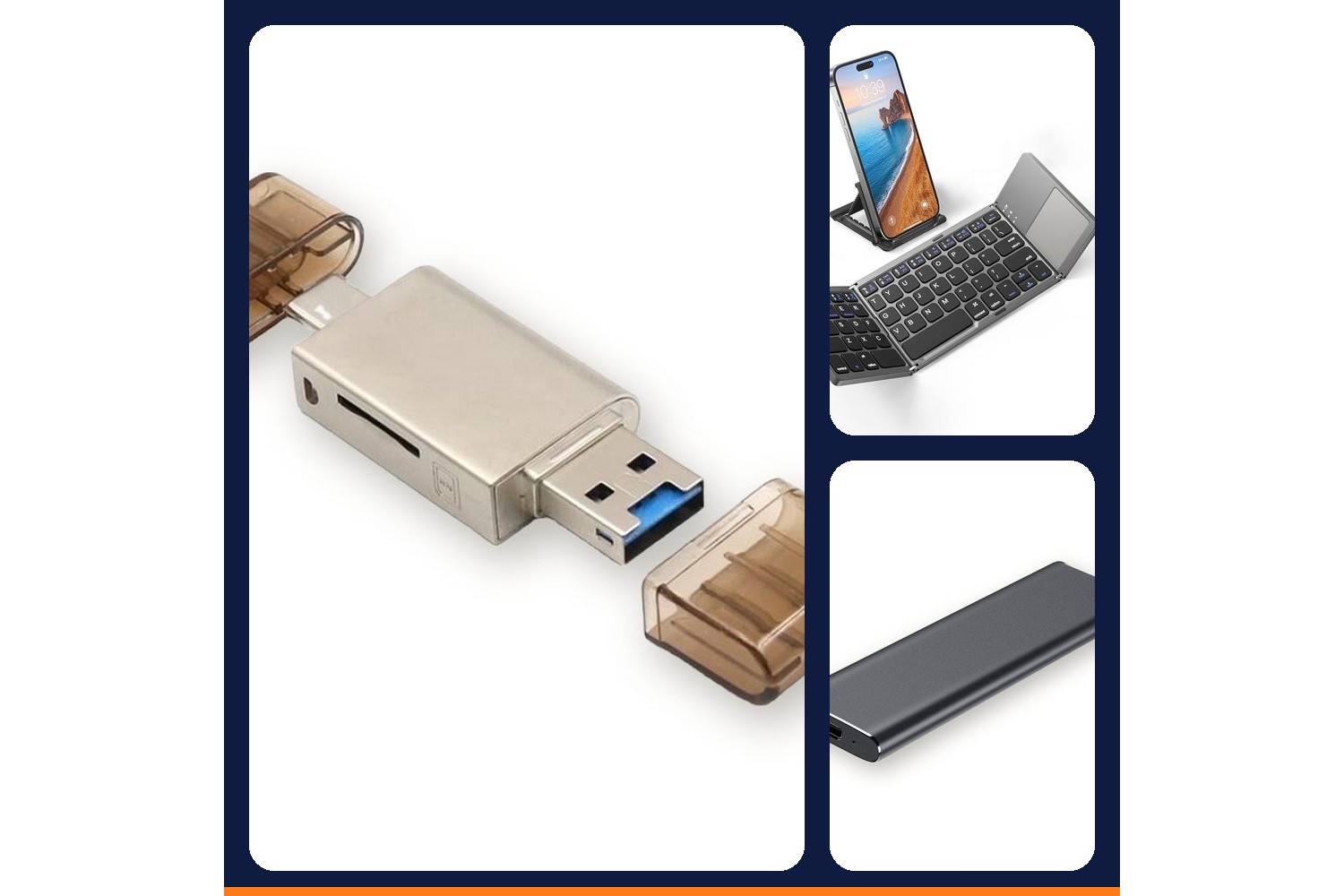
The third is small connectivity devices. A card reader or adapter is inexpensive, sells all year round and fits into compact branded packaging that hangs easily on a retail hook.

A card reader with USB-A and Type-C plugs: a small product recognised by its neat branded packaging.
Keyboards and mice come as a second step. There are more variables here: layout by country, radio module, battery, software. In return, the brand is most visible on these products.

A folding Bluetooth keyboard with touchpad: a line for the second wave, once the brand is ready for more complex electronics.
Three levels: logo, own packaging, OEM/ODM
The entry level is a logo applied to a catalogue model: printing on the fabric of a mouse pad, engraving on aluminium, pad printing on plastic. The service is offered for more than 8,000 items; the terms are set out on the Private Label page.
The next level is packaging in your own style. For accessories it is also a working tool: it carries the list of compatible devices, interfaces, contents and brief instructions in the local language. A good box settles half the questions before purchase.
The top level is production to your specification (OEM/ODM): your own design and size of mouse pad, case colour, set of ports, keyboard layout, cable set. It requires a larger run and more time, so it is approached with sales data rather than guesses.
Name and trade mark
Electronics is full of short, similar names, so a check is essential. Search the public databases: trade mark rights are obtained from a national office, or from the EUIPO when protection is needed across the whole EU at once. The application lists classes of goods – computer peripherals fall into one, and clothing or bags, should you plan merchandise, into others.
Filing details, timing and fees differ between offices; it is safer to go through the process with a trade mark attorney. One rule is specific to this niche: do not place other companies’ trade marks on the product or in the description as though the item came from their owner. Stating what a product is compatible with is acceptable; passing it off as another brand’s original accessory is not. The same applies to game characters and team logos on mouse pads: they require a licence.
Packaging and labelling
The product or packaging must carry the information required by the EU General Product Safety Regulation (GPSR): details of the manufacturer and of the responsible person in the EU, and a model or batch reference. Electronic devices bear CE marking and must comply with RoHS restrictions; wireless models are subject to radio equipment requirements and battery-powered devices to battery requirements. Request all supporting documents through your account manager before payment and check that they name your model.
A mouse pad without electronics has fewer requirements, but it needs the GPSR details too. Find out in advance which disposal markings for packaging and electronics are used in the countries where you sell, and which language the instructions must be in.
From sample to batch
- Sample. Agree a sample or a small trial batch with your account manager. Connect the device to several computers, measure speed, check heat and build quality; on a mouse pad, assess the base and edges.
- Artwork. Supply the logo as a vector file, the print design at the required resolution and the packaging text.
- Approval. The manufacturer confirms placement and method, and you approve the artwork. A quotation with run size and lead time follows, then a pro forma invoice.
- Production. Payment is made by bank transfer in EUR or PLN, after which the run goes into production. Artwork and manufacturing are added to the usual delivery time.
- Quality control. Before dispatch there is a quality check of the batch: printing, device function, completeness.
- Delivery. You are given a tracking number and documents. Delivery is available to any EU country, with 20–60 days as a guide.
To see net prices and send an enquiry you need a wholesale buyer account.
What the budget consists of, and common mistakes
The calculation includes: goods at the price of the relevant volume tier, samples, design preparation, branding, packaging print, delivery for the consignment, trade mark costs, photography for listings and a reserve for warranty replacements. The minimum order is 500 EUR net, and the account manager states the smallest branded run for each item.
- Starting the brand with a complex wireless device rather than a mouse pad or enclosure.
- Ordering a run of keyboards with a layout unsuited to the country of sale.
- Printing specifications on the packaging that were not verified on the sample.
- Using other parties’ logos and characters in the design.
- Accepting documents issued for a different model.
- Planning a launch for September or November with no margin: seasonal batches are ordered 2–3 months ahead, and branding lengthens the lead time.
Frequently asked questions
Which product should a computer accessories brand start with?
A mouse pad or a simple accessory with no radio module or battery. Such a product is easier to test, brand and document, and mistakes in the first batch cost less.
Can a mouse pad be made with my own design?
Yes, if the model offers custom printing. Send a design you hold the rights to and ask your account manager about file requirements, available sizes and the minimum run.
What can be said about compatibility with other brands’ devices?
Only verified facts: interface type, supported formats, system versions. Names of other companies’ devices are acceptable as a statement of compatibility, but not in your brand name and not as logos on the packaging.
How long does a batch with a logo take?
Standard delivery takes an estimated 20–60 days. Artwork, approval and production add time, and the exact lead time is given in the quotation.
Choose the first product for your brand in the computer accessory shop supplies section and ask about branding terms. If the shop’s range is not settled yet, first read the article on launching a computer accessories shop.
