
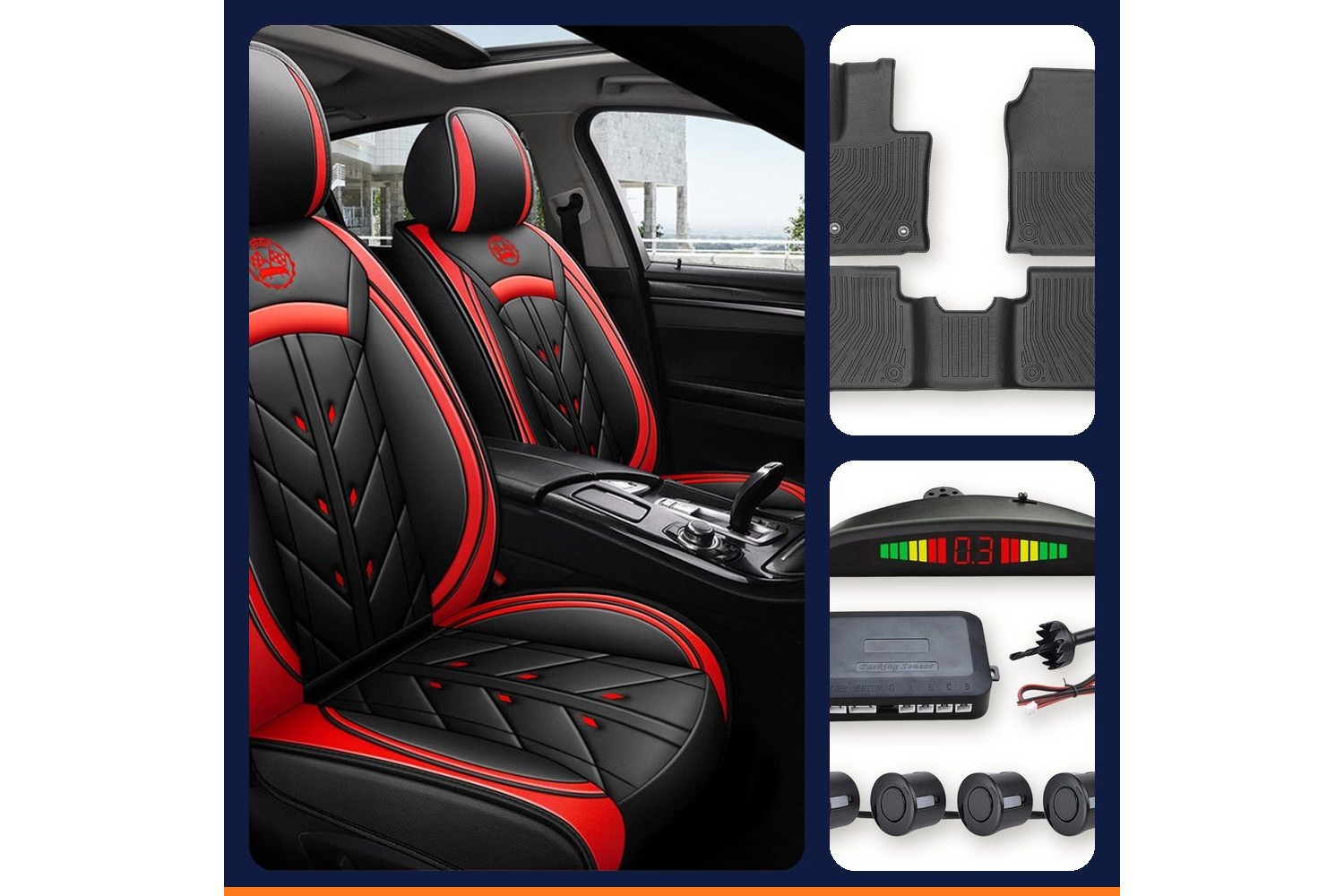
Your own brand in car styling does not start at a factory. It starts with a logo on goods that already sell: a set of seat covers, mats, a steering wheel cover, an interior lighting kit. Buyers choose these things with their eyes – by material, colour and packaging – so the brand really does influence the choice. Below: which items suit your own brand, how the three levels of branding differ and how to get from sample to batch.
In brief
- Start with a logo on a finished product; your own packaging is the second step, a product made to your requirements the third.
- Interior accessories suit a brand best: seat covers, mats, steering wheel covers, lighting kits.
- The method – printing, embossing or engraving – is chosen to suit the material.
- Check the name in trade mark databases before ordering a batch; the mark must not resemble vehicle manufacturers’ emblems.
- Branding lengthens the lead time: artwork and production are added to the 20–60 days of delivery.
Why a brand matters in this niche
The first reason is nameless goods. Seat covers, mats and steering wheel covers look alike on Amazon or eBay, and buyers sort them by price. Your own mark, packaging and a clear range take the product out of that comparison.
The second is repeat purchases. Someone who bought a steering wheel cover and liked it will come back for seat covers and mats of the same brand – if they can find it. Nameless goods offer no such chance.
The third is the studio as a shop window. If you have a fitting bay, every job shows the accessories in use: before-and-after photos work for both the service and the brand.
The fourth is business orders. Used-car dealers, taxi firms and hire companies need identical sets for a whole fleet; a brand with a stable range is more convenient than one-off purchases.
Which products suit your own brand
Choose items with room for a mark and without third-party emblems. Leave complex electronics under your own brand for later: there the brand owner takes on more documentation duties.
Seat covers. The most visible part of the interior. The mark goes on the backrest or headrest, and the range is built on colours and textures of one model. Models are in the ‘Seat covers’ category.

A universal five-seat cover set – a core model recognised by its mark and branded box.
Mats. The mark goes on the mat itself or on the packaging and insert. Several colours of one model give a range without new artwork. See the ‘Mats’ category.

Model-specific mats in six colours: one shape, one mark – and the colour range is ready.
Steering wheel covers and small trim. Inexpensive items through which a buyer first meets the brand. Packaging matters most here: it should show texture and size.
Interior lighting kits. A strip, controller and remote in a branded box with instructions in the buyer’s language come across as a finished kit rather than a reel. The basis is in the ‘LED strips’ category. Offer such a kit for the interior only.

A 12 V RGB strip with controller and remote – the basis of a branded interior lighting kit.
Three levels: logo, packaging, OEM/ODM
Logo on a finished product. You choose the model and colours, and the manufacturer applies the mark. This is the fastest route and a convenient test of demand. Terms are set out on the Private Label page; branding is available for more than 8,000 items.
Your own packaging. A box or bag in your design, an insert with instructions, labelling for your market. From this point the shelf holds a branded product, not seat covers with a logo.
OEM/ODM. A product made to your requirements: material, stitching colour, perforation pattern, kit contents. Move to this level once the core range sells and you know what finished models lack. Details are on the OEM/ODM manufacturing page.
Name and trade mark
The name must be legible at small size: on a headrest, the rim of a mat, the end of a box. Prepare two versions of the mark – a full one for packaging and a simplified single-colour one for embossing.
A trade mark is registered with a national office or with the EUIPO for the whole EU. Check the name in open databases before ordering a batch. A rule specific to this niche: do not use the emblems or names of vehicle manufacturers and models as part of your brand. Stating which car a product fits is fine; presenting that as your own mark is not. Procedure and cost depend on the office; if in doubt, consult a trade mark attorney.
Packaging and labelling
Packaging does the selling here. Seat covers and mats need a photo of the product in a car, a fitting diagram and a compatibility list; online sales need a sturdy shipping box and space for a barcode. Pack bulky sets compactly: dimensions affect the delivery cost.
Labelling is the brand owner’s responsibility. Under the EU General Product Safety Regulation, the product or packaging shows the details of the manufacturer and the responsible person in the EU; instructions and warnings are given in the language of the country of sale. Claim that seat covers are compatible with side airbags only if the manufacturer confirms it. Lighting kits are electronics: they need the CE marking and compliance with EU requirements, including RoHS. Request documents from the manager before payment.
One more boundary: exterior lighting, parts that alter construction and exhaust systems require type approval or authorisation under national rules. Do not put such goods under your brand without checking the local procedure.
From sample to batch
- Complete the wholesale registration and send an enquiry: models, colours, quantities, method and position of the mark.
- A sample or a small trial batch is by agreement with the manager. Fit the covers and mats in a car; check the material, smell and seams.
- Prepare the artwork: logo in vector format, size in millimetres, colours, box dieline and insert text.
- Approve the artwork and the quotation; then comes the pro forma invoice and payment by bank transfer in EUR or PLN.
- Production: products, branding, packaging.
- Quality control before dispatch: position of the mark, colour, completeness, condition of the packaging.
- Dispatch and a tracking number. The indicative lead time is 20–60 days plus time for artwork and production; terms are on the delivery page.
What the budget consists of, and common mistakes
A brand budget is made up of the products themselves, branding, packaging and inserts, design of the mark and artwork, trade mark registration, delivery quoted per consignment, and photography of the product inside a car. The minimum order value is EUR 500 net; the unit price depends on the volume tier. Plan the first batch as a test: one or two models in a few colours.
What to avoid:
- a mark resembling car makers’ emblems, and third-party logos on the product;
- launching with complex electronics instead of simple interior accessories;
- ordering a batch without fitting the sample in a car;
- claims on the packaging that cannot be backed up, such as ‘fits all models’;
- too wide a colour palette in the first batch;
- a late start: a branded range for the spring season is prepared from autumn.
Frequently asked questions
Should the range start with seat covers or mats?
With what you already sell and know well. Seat covers are more visible and show the brand better; mats and steering wheel covers are simpler logistically and handier for a first test.
From what quantity can branding be ordered?
Many items have a minimum quantity of 1–10 pieces, but the terms for branding depend on the model and method – they are confirmed in the enquiry. The order as a whole starts at EUR 500 net.
Can the packaging say which cars the product fits?
Yes, compatibility is ordinary buyer information. What you may not do is use vehicle manufacturers’ emblems in the design or give the impression that they made the product.
How long does the launch take?
Sample, artwork and branded production are added to the indicative 20–60 days of delivery. Seasonal goods are ordered 2–3 months ahead, so work on an own-brand range starts earlier still.
Choose one or two core models in the ‘Auto tuning shops’ section, prepare a simplified mark and start with a small batch. If you do not yet have a sales outlet, first read the article ‘How to open a car tuning shop or studio’.
