
A café brand is built not by the sign above the door but by the things a guest holds: the glass, the takeaway cup, the napkin, the box with a dessert. To make them work for the venue, it is enough to choose a few items, apply the logo and order a batch from a supplier that takes care of production and quality control. This article explains which products suit a venue's own brand and how to get from a sample to delivery.
In brief
- Start with what the guest sees most often: glassware, cups and packaging for takeaway orders.
- There are three levels: a logo on a finished product, your own packaging and production to your specification (OEM/ODM).
- The name and logo are checked and registered as a trade mark before the run is printed.
- Branding extends the lead time by the artwork and production stage, so the order is planned in advance.
- Merchandise for sale is a product in its own right: labelling and product safety requirements apply to it.
Why a café needs its own brand on tableware and packaging
In hospitality, the guest remembers the impression rather than the name. Branded tableware and packaging link that impression to a specific venue. A cup with a logo leaves the room with the guest, a bag with an order ends up in an office or at home, and an engraved glass appears in photographs.
The second reason is practical. A single style for tableware, napkins and packaging simplifies purchasing: instead of random items from different sources, there is a list of branded articles reordered on a schedule. For a business with several sites, it is also a way of keeping the presentation consistent.
The third reason is an additional shop window. Mugs, glasses and accessory sets under the venue's brand can be sold to guests and given to regular and corporate clients. It does not replace core revenue, but it anchors the brand outside the room.
Which products suit a venue's own brand
Glass is the easiest place to start. Glass tumblers and wine glasses take engraving and printing well, last a long time and are constantly in front of the guest. The second group is cups and mugs for takeaway drinks: for a coffee shop, this is the logo carrier with the highest volume.

A crystal wine glass: an engraved logo makes it part of the venue's own style of service.
Steel bar and serving tools are suitable for engraving: tongs, ice buckets, shakers. Guests see them less often, but they set the level of service and look good in gift sets.

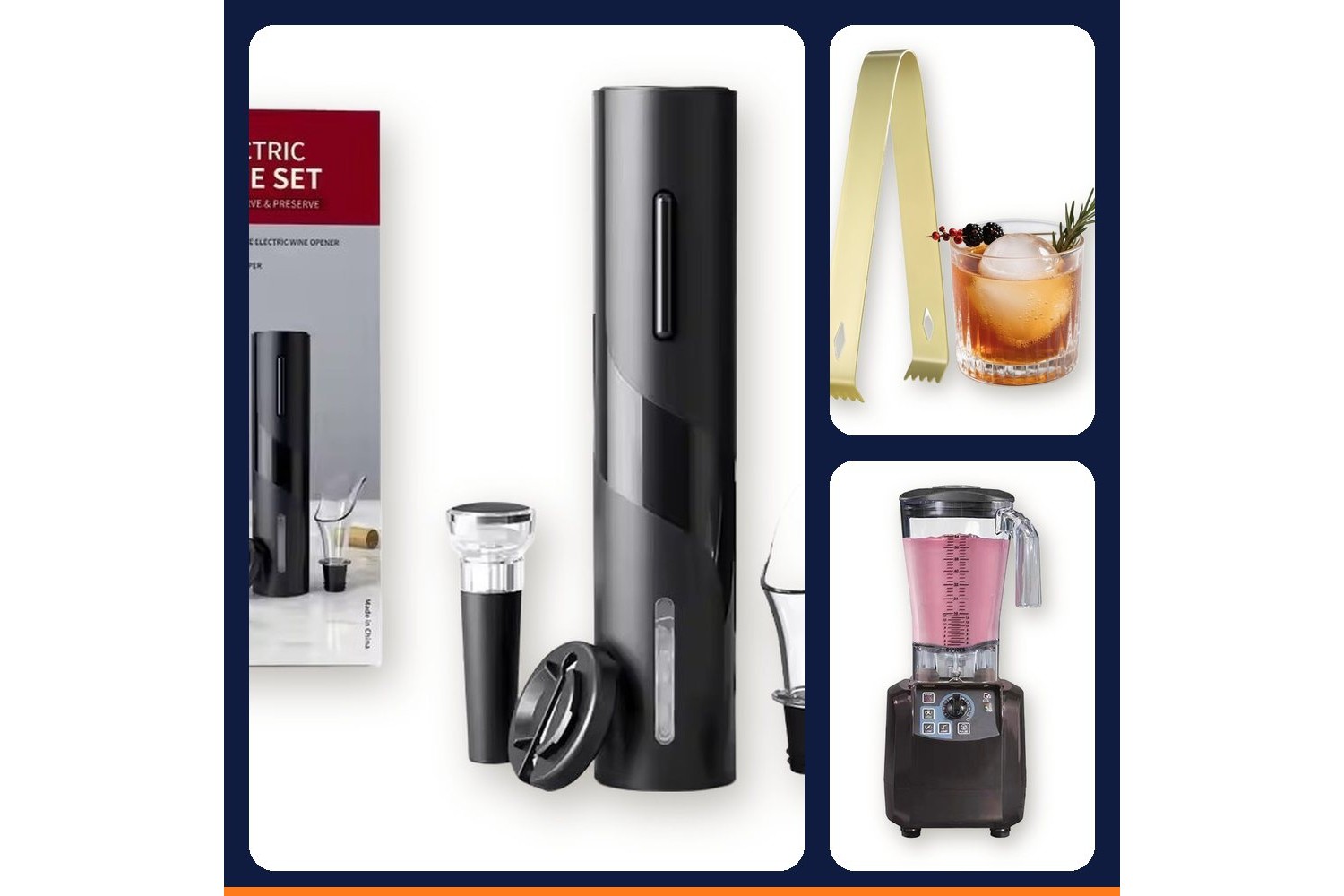
Steel ice tongs: a small item on which an engraving lasts a long time.
Consumables – napkins, drinking straws, disposable cutlery – are branded through the packaging or by printing on the item itself. Natural materials are the right choice here in terms of both the rules and the impression.

Bamboo straws: a natural material that can carry a logo or be supplied in branded packaging.
Products for sale and for gifts are a separate group. A wine bar or restaurant can use corkscrews and openers in a gift box; a coffee shop, mugs and accessories for making drinks at home.

A set with an electric wine opener in a gift box – a ready-made basis for a wine bar souvenir.
Three levels: logo, own packaging, OEM/ODM
The first level is a logo on a finished product from the catalogue. The method depends on the material: printing, engraving or embossing. This is the fastest route, and it is available for more than 8,000 items. How it works is described on the Private Label page.
The second level is your own packaging. The same glass or cutlery set is supplied in a box with your design, an insert and labelling for the target market. For merchandise on sale this step is essential: the packaging carries both the brand and the information required by the rules.
The third level is production to your specification (OEM/ODM): your own glass shape, colour, capacity and set contents. It makes sense when the venue already knows which items sell steadily and is ready for a larger run and a longer lead time.
Name and trade mark
Before printing a logo on a production run, make sure the name is free. A trade mark is registered with the national office or, for protection across the whole EU, with the EUIPO. A mark is registered for specific classes of goods and services: café services and goods bearing the logo – tableware, clothing, souvenirs – fall into different classes, which matters if you plan to sell merchandise.
A search in the offices' public databases can be done independently, while the application is best discussed with a trade mark attorney. Procedure, timing and fees depend on the country and the office chosen. Other parties' logos, characters and recognisable design elements must not be used on your own products.
Packaging and labelling
For tableware used in the room, sound transport packaging is enough. For products sold to guests, the packaging is part of the product. Under the EU General Product Safety Regulation (GPSR), the product or its packaging shows the details of the manufacturer and of the responsible person in the EU, together with information identifying the product.
Tableware and items that touch food and drink must comply with EU rules on food contact materials. Electrical accessories must carry the CE marking. Certificates and declarations are requested from the manufacturer before payment. Selling alcohol and food requires permits under national rules; branded accessories and tableware are not part of that regulated area, but the labelling language and local packaging requirements should be clarified early.
From sample to batch
- Sample. Choose items in the catalogue and request a sample or detailed photos and specifications: material, capacity, branding method.
- Artwork. Prepare the logo in vector format and specify the colours. The account manager confirms the print area and method with the manufacturer.
- Approval. You approve the artwork and receive a quotation with the price, minimum quantity and lead time, followed by a pro forma invoice.
- Production. After payment by bank transfer, the run goes into production. Branding extends the lead time compared with goods without a logo.
- Quality control. Before dispatch the batch goes through a quality inspection: branding, completeness, packaging.
- Delivery. After dispatch you receive a tracking number and the documents. The estimated lead time is 20–60 days, and delivery is available to all EU countries.
To see net prices and send a request, complete the wholesale buyer registration.
What the budget is made of and typical mistakes
The budget for branded products consists of the cost of the items by volume tier, artwork preparation and branding, your own packaging if needed, samples, delivery calculated for the batch, and the cost of registering the trade mark. The minimum order value is 500 EUR net; the minimum branded run depends on the item and the method and is stated in the quotation.
The same mistakes recur from venue to venue:
- branding everything at once instead of the two or three most visible items;
- printing the run before checking that the name and logo can be protected;
- approving artwork from an on-screen image without confirming the size and method on the actual item;
- ordering branded tableware for the opening or for the season with no time margin for artwork and production;
- selling merchandise without labelling and the details of the responsible person in the EU;
- choosing an unusual shape that cannot be reordered later in the same form.
Frequently asked questions
Which item should a café start its branded range with?
The one a guest sees on every visit. For a coffee shop it is the takeaway cup; for a bar or restaurant, the glass used in the room. One or two items are enough to check the artwork and branding quality before extending the range.
How long does an order of tableware with a logo take?
The estimated lead time for goods is 20–60 days. Branding adds the artwork, approval and production stages, so the exact lead time is stated in the quotation. For the season and for holidays, the order is placed 2–3 months ahead.
Can merchandise under the venue's brand be sold to guests?
Yes, but such goods must meet EU safety and labelling requirements, and the name should be protected by a trade mark in the relevant classes. Tax and registration matters for retail sales depend on the country – check them with your accountant.
Is a large run needed to apply a logo?
Not necessarily. The minimum quantity depends on the item and the method: for engraving and printing on a finished product it is usually lower than for production to your own specification. The exact terms for each item are given in the quotation.
Choose two or three items to start your branded range in the products for cafés and restaurants section and request a quotation with logo branding. If the venue is still preparing to launch, start with the article on equipping a café for opening.
