
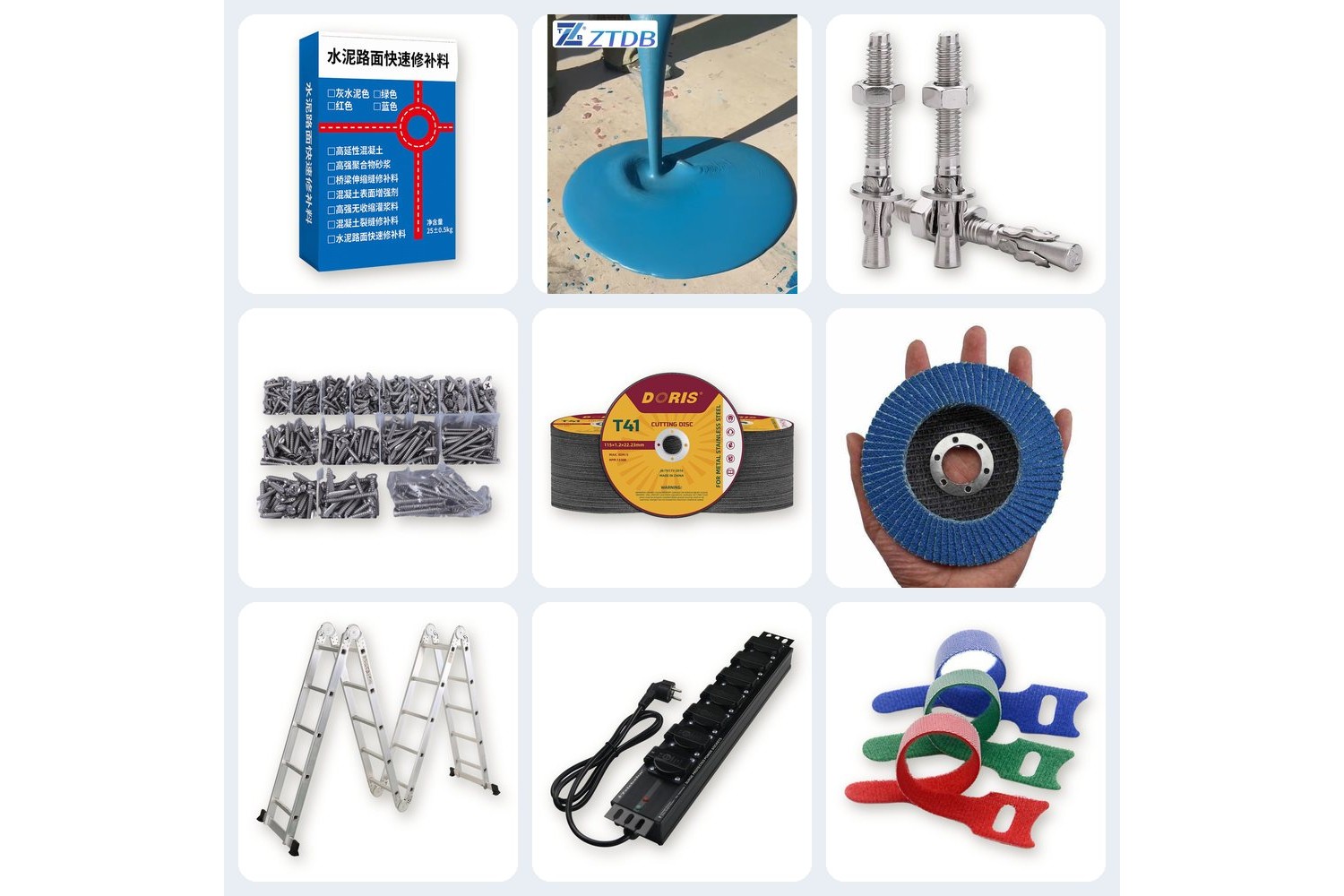
In 2027 the building supplies that sell best are those that help to repair rather than build from scratch: repair mortars, fasteners, consumables for power tools, small plumbing and electrical items. The buyer is both the tradesperson and the homeowner who does much of the work alone. Below are six directions visible in the EnjoyCommerce catalogue and in general demand, with product examples and advice on testing each one with a small batch.
In brief
- Repair compounds sell for a specific job: a pothole, a crack, an uneven floor.
- Stainless fasteners are replacing galvanised ones wherever a structure stands outdoors or in a damp room.
- Consumables are a repeat purchase: a tradesperson who likes a disc comes back for it.
- Mortars and ladders are heavy, bulky freight: work out delivery before ordering and match the shelf life of mortars to your sales plan.
Construction supplies trends for 2027
1. Repair instead of replace
Concrete yards, ramps and garage floors are increasingly patched rather than poured again: for the owner it is quicker and simpler. Hence the demand for ready-made repair compounds – fast-drying, so the surface can be used without long downtime, and self-levelling, which need no plasterer's skill. They are bought by warehouse and car park operators, garages and homeowners. In the description, layer thickness, time to loading and coverage per square metre matter – take them from the manufacturer's technical data sheet. The products are in the building mixes subcategory.

Fast-drying concrete repair mortar: patching potholes in yards, ramps and garages without long downtime.

Coloured self-levelling compound: an even floor in the warehouse, workshop and garage.
2. Stainless steel for outdoors
Decking, carports, fences, façade structures, solar panels on the roof – all are fixed outdoors, where galvanised hardware rusts over time and leaves streaks. Stainless is chosen where redoing the job would cost more than the fasteners themselves. In retail a second format works well: an assortment of common sizes in an organiser box, which the DIYer buys once and keeps in the garage. The range is in the fasteners section.

A 304 stainless wedge anchor in M6–M20: fixing to concrete outdoors and in damp rooms.

An M3–M6 screw assortment in a box: a ready item for the shop shelf and for Amazon or eBay.
3. Consumables for cordless tools
The cordless angle grinder has become an everyday tool with demands of its own: a thin cut-off wheel removes less metal, cuts faster and spares the battery. Flap discs are bought for dressing welds and removing rust. Sell consumables in packs and carry the full grit range, so the tradesperson does not look elsewhere for the missing grade. See the consumables subcategory.

A 1.2 mm cut-off wheel for metal and stainless steel: the common 115 mm size for angle grinders.

A flap disc in grits from 24 to 120: dressing weld seams and removing rust.
4. One ladder for every job
Space is short at home and in a tradesperson's van, so instead of a stepladder, a leaning ladder and a platform, people buy one hinged model that folds into any of these shapes. What matters to the buyer is documented compliance with the European ladder standard and a stated load rating: without them neither the professional nor the cautious private customer will buy. Models are in the ladders subcategory.

A 4 × 5 step hinged ladder: stepladder, leaning ladder and work platform in one product.
5. Order among the cables
A home office, a server rack in a small company, a workshop with a dozen chargers – cables multiply and tidy routing comes to the fore. Demand is growing for rack-mount power strips with surge protection and for reusable ties that need not be cut every time a cable is moved. These goods are light and convenient to sell online. They are gathered in the electrical section.

A 7-socket Schuko strip with surge protection for a 19-inch rack: for server rooms and workshops.

A reusable hook-and-loop tie: cables are rerouted without a knife or new ties.
6. A bathroom refresh without renovation
Not everyone is ready to replace tiles and pipes, but a shower head or hose is something the customer swaps alone in a few minutes. A shower head with a filter and several spray modes is an example of a product that sells on its picture and suits marketplaces. The second part of the section is PP-R fittings for installers: here the full range of diameters and steady availability matter. Both groups are in the plumbing subcategory.

A three-mode shower head with a filter: a do-it-yourself swap and an item for the online shop window.
How to test a trend with a small batch
The minimum order value at EnjoyCommerce is EUR 500 net per item. Building supplies are tested at work, so it makes sense to hand a sample (EUR 150, refunded when you place the order) to a tradesperson or crew you know.
- Take two or three directions. It is easiest to start with light, compact goods – fasteners, discs, electrical items – and add mortars once the delivery cost is clear.
- Register as a wholesale buyer and ask the manager for technical data sheets and, for mortars, the safety data sheet and production date.
- Try the discs on real metal: how many cuts one disc lasts, whether the edge crumbles. Compare with what the tradesperson uses now.
- Mix the mortar strictly to the instructions and pour a test patch: check the setting time and the state of the surface after a few days.
- Measure fasteners with a calliper and check the steel marking; open the ladder into every position and test the hinge locks.
When to order: seasonality and timing for 2027
The indicative lead time is 20–60 days, and the cost of delivery is calculated per batch; for bagged mortars it is driven by weight. Order seasonal goods 2–3 months ahead and allow for the factory break over Chinese New Year at the start of the year.
- Mortars for outdoor work are needed from the start of the warm season. Order in January–February; do not build a large stock, as dry mixes have a limited shelf life.
- Fasteners and consumables sell all year, more strongly in spring and summer. Order in December–January, then replenish as sales require.
- Ladders sell in spring, when work on façades and gardens begins, and in autumn. Order in January and in June–July.
- Electrical and plumbing items pick up in autumn and winter, when renovation moves indoors. Order in July–August.
Frequently asked questions
What documents do building supplies need in the EU?
It depends on the group. Some construction products, including certain anchors and mortars, require a declaration of performance and CE marking in the EU; electrical goods carry CE marking too. Ladders are tested to the European standard EN 131. Mortars need a safety data sheet and labelling in the language of the country of sale. Ask the manager for the documents before payment; before dispatch the batch goes through quality control.
Will the sockets and plugs suit my country?
Schuko sockets are standard in Germany and a number of other countries, but not across the whole EU: France, Poland, Italy and some other states use their own types. State the country of sale in your enquiry and the manager will check the available versions with the manufacturer.
Can I sell fasteners and discs under my own brand?
Yes. Private Label is available for more than 8,000 catalogue items: for fasteners and discs it mainly means branded packaging, a label and marking for your market. An own brand supports repeat sales – the tradesperson remembers the pack and looks for it again. Branding extends the lead time by the artwork and production stage.
The bottom line
The construction trends of 2027 are repair instead of replacement, fasteners and consumables made to last, and products the customer fits without help. Open the Construction section, pick items for a trial batch and write to the manager, who will prepare an offer with prices and lead times.
